[00:00:08]
Alessia: Welcome back to the Magic Towns Italy podcast with Miles and Alessia.
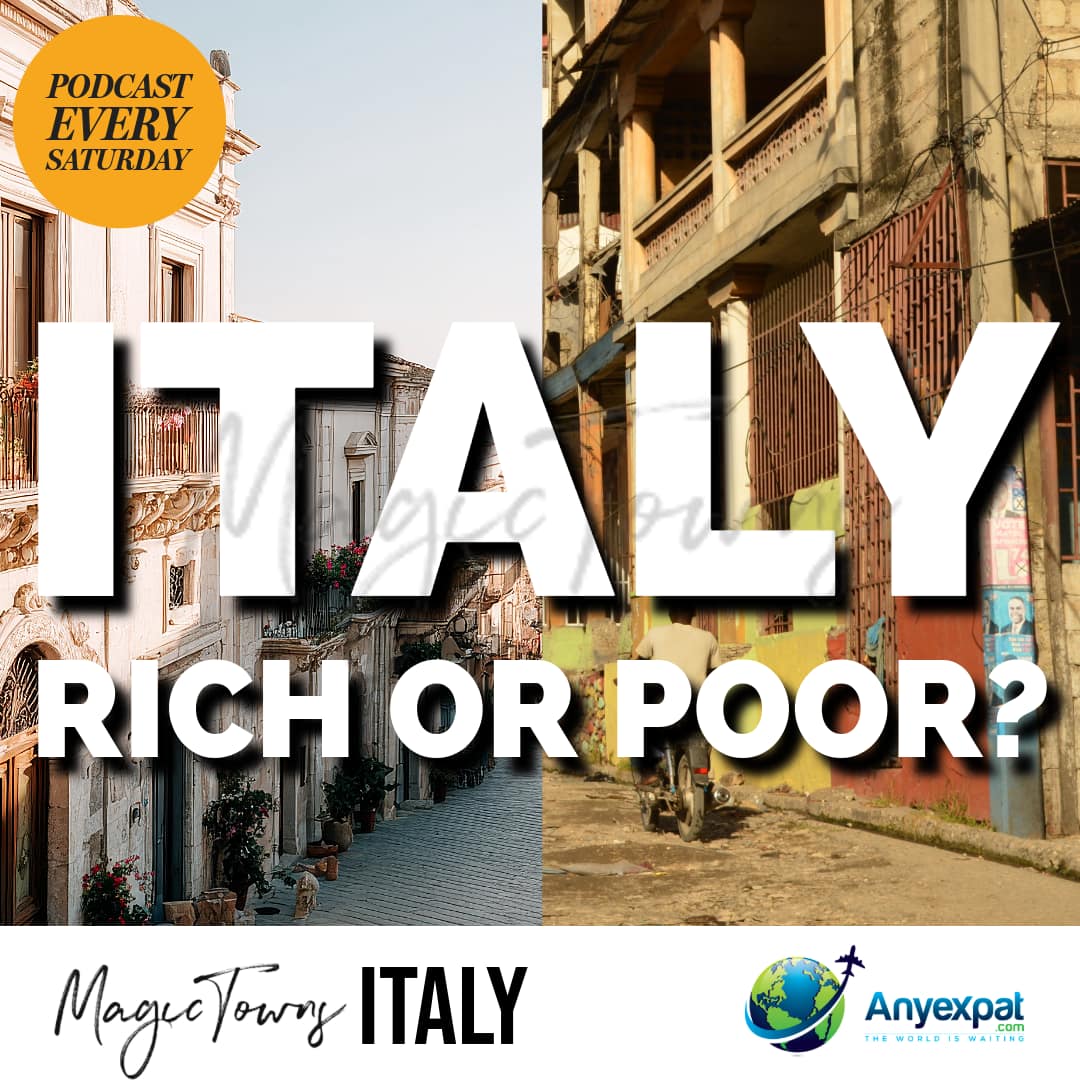
[00:00:12] Italy. It’s a country that, well, it brings up these images of just stunning beauty rich culture.
[00:00:19] The ultimate Dolce Vita.
[00:00:20]
Miles: That classic image right.
[00:00:22]
Alessia: But then the headlines often paint a really starkly different picture, one of economic struggle. It feels like a real paradox, doesn’t it?
[00:00:29]
Miles: How can a nation seem poor by some measures, yet offer such an undeniably high quality of life?
[00:00:35]
Alessia: It’s a question lots of people have, especially if you’re drawn to Italy, maybe thinking of visiting or even moving there. We’ve gathered some really insightful sources, that get into these realities and stereotypes to help understand what we’re calling Rich Italy, Poor Italy, these two distinct identities kind of woven together.
[00:00:52]
Miles: Mm-hmm.
[00:00:53]
Alessia: The way to sort of solve this puzzle lies in the country’s really profound regional differences
[00:00:59]
Miles: That North South divide.
[00:01:00]
Alessia: Yeah, that famous North-south divide.
[00:01:02] It’s so pronounced that the average Italian experience you read about it often just doesn’t really exist.
[00:01:08]
Miles: You really have to look closer. Okay, so let’s start untangling this. When we talk about poor Italy, what are the main things driving that perception? Is it mostly that high public debt? We hear so much about. That’s definitely a big part of it. The poor country image comes from a few connected issues. High public debt is constantly flagged.
[00:01:24] Then you’ve got those headlines about youth unemployment. It’s been stubbornly high, particularly down south in the Mezzogiorno.
[00:01:31] And then there’s the decades of pretty low economic growth compared to neighbors like Germany plus, you know, media sometimes highlighting older infrastructure.
[00:01:39] It all adds up.
[00:01:40]
Alessia: So it’s easy to just look at the numbers. Italy’s overall income. Employment rates may be lagging behind Northern Europe and think, okay, perpetual crisis, which is what a lot of headlines suggest.
[00:01:50] What’s hiding beneath those surface stats?
[00:01:53]
Miles: And this is where the counter narrative comes in the Rich Italy story, because when you shift focus to things like human development, overall wellbeing, Italy starts looking decidedly rich.
[00:02:03]
Alessia: Okay, this is where it gets really interesting. For me. Italians have one of the highest life expectancies like in the world.
[00:02:09] It’s quite something. So Italy actually tops the EU even higher than places like Germany or the Uk, which we might think of as richer. That’s amazing.
[00:02:18]
Miles: It is remarkable. According to the latest Eurostat data for 2024, a baby born in Italy can expect to live around 84.1 years. Which, yeah, essentially ties Italy with Sweden for the longest lifespans in the entire EU.
[00:02:32]
Alessia: And that’s way above the average, the full 2.4 years longer than the EU average of 81.7 years.
[00:02:37] And this high longevity, it’s seen as a really powerful shorthand for overall living conditions. It kind of pushes back against that idea of a nation just struggling constantly.
[00:02:49]
Miles: It suggests that despite economic challenges, Italians really benefit from things like, well, the famous Mediterranean diet. Of course, those incredibly strong family support networks, which boost social wellbeing and a pretty effective healthcare overall, especially in the more developed north.
[00:03:06]
Alessia: So it’s not just about how much you earn, but how income, culture, lifestyle, all combine into actual wellbeing. It’s not just long lives, but also like foundational financial security.
[00:03:15] High household wealth.
[00:03:16]
Miles: Yeah, this is a crucial point, often missed. If you only look at GDP. Italians have built up significant household wealth. A lot of that is down to strong family saving habits and really high rates of home ownership passed down through generations.
[00:03:30]
Alessia: So people own their homes.
[00:03:31]
Miles: Very high rates, and because of this, severe material deprivation, meaning you can’t afford basics like food, keeping your home warm, things like that, it’s relatively uncommon.
[00:03:40]
Alessia: How uncommon are we talking? The rate is roughly four or 5% , so over 95% of Italians can afford the essentials. That’s much better than quite a few other European countries, right?
[00:03:51]
Miles: Significantly better than many Eastern European countries, for instance. And this directly challenges that simple poor label. It shows a basic financial security built on assets, not just yearly income. It’s like hidden wealth.
[00:04:04]
Alessia: Okay. To really get it, we have to dive into those regional differences. You mentioned, we hear that cliche, rich industrial North, poor agrarian South. Is that just a stereotype or is there real truth to it?
[00:04:16]
Miles: Oh, there’s significant truth to it. It’s probably the defining internal dynamic of Italy, actually. If you look at almost any socioeconomic measure, the North and South are very different.
[00:04:26] Take economic output, GDP per capita. Northern regions like Lombardy around Milan. They boast a GDP per capita around 127% of the EU average. That’s up there with prosperous parts of Germany, even Scandinavia.
[00:04:42]
Alessia: Right, like Bavaria levels.
[00:04:43]
Miles: Exactly. Rich European region, territory. It’s a stark contrast. Calabria down in the toe of the boot produces only about 56% of the EU average per capita.
[00:04:53]
Alessia: 56% compared to 127%. That’s huge.
[00:04:57]
Miles: It’s massive. To put in perspective, the average income in Calabria is similar to Bulgaria in Lombardy it’s like the Netherlands
[00:05:04]
Alessia: Within the same country.
[00:05:06] That’s wild.
[00:05:06]
Miles: It’s an enormous gap and it fuels so many other differences we see
[00:05:10]
Alessia: Like poverty risk. How does that North South thing show up there?
[00:05:13]
Miles: This is where the gap just looks like a chasm.
[00:05:15] Basically how many people struggle to afford basics and might feel shut out from society. In Italy this ranges from literally the best in Europe to among the worst.
[00:05:24]
Alessia: Seriously, the best and worst.
[00:05:26]
Miles: Yeah. Look at the autonomous province of
Bolzano way up in the Alps, only 5.8% of people there are at risk of poverty or social exclusion. That is the lowest regional share in the entire EU.
[00:05:38]
Alessia: The lowest in all of Europe and the South.
[00:05:40]
Miles: Contrast that with Calabria, again, nearly 49% of residents live at risk of poverty. Almost half the population. And Campania around Naples is close behind at 44%. It’s an extraordinary difference. You could move from Calabria to Bolzano and go from one of Europe’s highest poverty risk areas to the absolute lowest.
[00:05:59]
Alessia: That’s just hard to wrap your head around. And does this affect life expectancy too, even though it’s high overall?
[00:06:05]
Miles: It does show up there too, though the gap isn’t as dramatic. Northerners live a few years longer than Southerners, roughly 83 years in the north versus 80 in the south.
[00:06:15]
Alessia: Still even 80 in the south is pretty good above the EU average.
[00:06:18]
Miles: It shows a generally high baseline of health across the country, but the North definitely has an edge.
[00:06:24]
Alessia: This huge economic gap must affect everything else.
[00:06:26] Jobs, education.
[00:06:28]
Miles: It creates a cycle. Unemployment in the south is often triple the rate in the north.
[00:06:32]
Alessia: Triple Wow. Yeah.
[00:06:34]
Miles: Which means many young, educated Southerners feel they have to migrate north for work, which then drains the south of talent.
[00:06:40]
Alessia: A brain drain essentially, pretty much. And educational outcomes tend to be better in the North too.
[00:06:45] Leading to better opportunities there. Why is the divide so deep though? What are the historical roots?
[00:06:51]
Miles: Well, it’s complex. You have historical factors. Going back to Italian unification in the 19th century, development policies often favored the North’s industrialization. The South remained more agrarian.
[00:07:03] Then you have the ongoing impact of organized crime in some areas, which holds back legitimate business and sometimes less effective governance historically in the South.
[00:07:12]
Alessia: So a mix of history, policy, and other challenges.
[00:07:15]
Miles: Right. The key thing for us is that Italy’s poverty isn’t spread evenly. It’s highly concentrated while other parts are as wealthy and efficient as anywhere in Europe.
[00:07:24] Milan or
Bologna probably have much lower poverty risk rates than say, average cities in France, but Calabria or Sicily have far higher rates.
[00:07:32] That crucial detail gets totally lost in country level numbers.
[00:07:35]
Alessia: It’s like averaging the temperature of Death Valley and Alaska and saying the US has a mild climate.
[00:07:41]
Miles: Precisely. Averages can hide more than they reveal sometimes.
[00:07:44]
Alessia: So while that poor Italy experience is definitely real for people, especially in parts of the South, it’s also not a static picture.
[00:07:51] Right? Things have been improving overall.
[00:07:53]
Miles: Yes. That’s important too. Our sources show a clear long-term decline in severe material deprivation right across Italy, particularly since the financial crisis back in 2008.
[00:08:03]
Alessia: So fewer people struggling for absolute basics.
[00:08:06]
Miles: Significantly fewer. The rate has roughly halved since its peak around 2012.
[00:08:11] It went from about 11% down to that four to 5% range we mentioned recently. That’s a major improvement in basic wellbeing for millions.
[00:08:20]
Alessia: That is real progress, especially given the tough economic climate sometimes, and you can even see shifts year to year in some region.
[00:08:27]
Miles: Yeah, the regional data is fascinating. Between just 2022 and 2023 a small southern region saw its poverty risk rate drop dramatically.
[00:08:37] It fell from around 37% down to 25%, a 12 percentage point drop in a single year. That’s huge.
[00:08:44]
Alessia: Wow. What caused that do we know?
[00:08:45]
Miles: The specific drivers aren’t always clear from just the headline numbers, but it shows positive change as possible.
[00:08:52] And other regions like Liguria and Bolzano up north also saw improvements.
[00:08:56]
Alessia: So the general trend seems positive for many places.
[00:08:59]
Miles: The overall trajectory for much of Italy is positive. Yeah. Poverty rates generally receding education levels, slowly rising, access to services expanding, but, and this is important.
[00:09:10] It’s not universal. Calabria already one of the poorest actually saw its poverty risk increase by about 5.8 points in that same 2022 to 2023 period.
[00:09:22]
Alessia: So convergence isn’t guaranteed. Some gaps might even be widening.
[00:09:26]
Miles: It highlights that progress is slow and definitely uneven, catching up as a long-term challenge for the southern regions.
[00:09:32]
Alessia: Still, despite those challenges and the unevenness. The big picture seems to be that Italy today is generally better off than say a generation ago.
[00:09:41]
Miles: I think that’s fair to say. Modern living standards, reliable infrastructure. You know, electricity, water transport, internet access is pretty widespread now and relatively low crime rates all contribute to a pretty solid quality of life overall.
[00:09:57]
Alessia: Even in rural areas.
[00:09:58]
Miles: Yeah, even rural areas benefit from decent infrastructure Italy’s fantastic highway network. It connects the country really effectively.
[00:10:06]
Alessia: Okay, so let’s bring this back to the listener. What does all this mean for you, especially if you’re maybe dreaming of Italy, thinking about visiting or even making a move?
[00:10:15]
Miles: Well, the main takeaway is location, location, location. It really matters. Your experience will depend hugely on which Italy you choose.
[00:10:23]
Alessia: Right? So a northern city like Milan, you’re looking at infrastructure services, maybe a job market that feel very Western European, maybe quite high end
[00:10:32]
Miles: Comparable to major cities in Germany or France, right?
[00:10:35] If you choose, say, a small town in Calabria
[00:10:37]
Alessia: might face more challenges like maybe infrastructure, isn, quite as slick job opportunities. scarcer,
[00:10:42]
Miles: More what you might call developing area challenges. But on the flip side, you’d likely find incredible cultural warmth, a slower pace of life, stunning natural beauty. Lower living costs too.
[00:10:54]
Alessia: Two very different experiences within one country.
[00:10:56]
Miles: But regardless of where you are, you still benefit from the national systems. Universal healthcare is a big one.
[00:11:02]
Alessia: So even in poorer southern towns, basic healthcare coverage exists.
[00:11:06]
Miles: Yes. The basics are there though, for highly specialized treatments, people might travel north to major centers, which have more resources and cutting edge facilities.
[00:11:14] But the foundational access is national.
[00:11:17]
Alessia: And I guess for many expats, especially if they have income from abroad or savings. Maybe they aren’t competing in the local job market.
[00:11:26]
Miles: Right. For them, Italy’s positives, the climate, the food, the history, that whole Dolce Vita vibe might easily outweigh any negatives.
[00:11:33] It’s about understanding the trade-offs and choosing what fits you.
[00:11:37]
Alessia: So wrapping this up then, poor Italy, rich Italy, it’s not just a phrase, it really describes this dual identity.
[00:11:43]
Miles: It really does. Italy often gets underestimated internationally because those standard economic stats like GDP growth don’t capture the full picture.
[00:11:51]
Alessia: They miss the high human wellbeing, the accumulated wealth.
[00:11:54]
Miles: They miss the long, healthy lives, the low levels of severe deprivation, the assets people hold. The affluent north drives a lot of the success and offers a very European standard.
[00:12:04]
Alessia: While the South has its struggles, but offers a different kind of richness, maybe a different authenticity.
[00:12:10]
Miles: A different but no less authentic Italian charm and reality.
[00:12:13]
Alessia: Yes,
[00:12:14]
Miles: The core message is Italy isn’t monolithic.
[00:12:16]
Alessia: You can find the comforts and efficiencies of a rich country, or you might encounter the challenges of a poorer region. Both are genuinely Italy
[00:12:25]
Miles: And embracing those contrasts is really part of the experience, part of what makes Italy so endlessly fascinating.
[00:12:31] Italy might not look rich on paper like Germany. And yes, it has real economic hurdles, but it’s definitely not uniformly poor. It’s a developed country, albeit one with pockets of underdevelopment and in its own unique way. Maybe it’s richer than it looks, especially when you consider health community that hidden household wealth.
[00:12:49] The things that often define the real Bella Vita.
Thanks for your feedback!