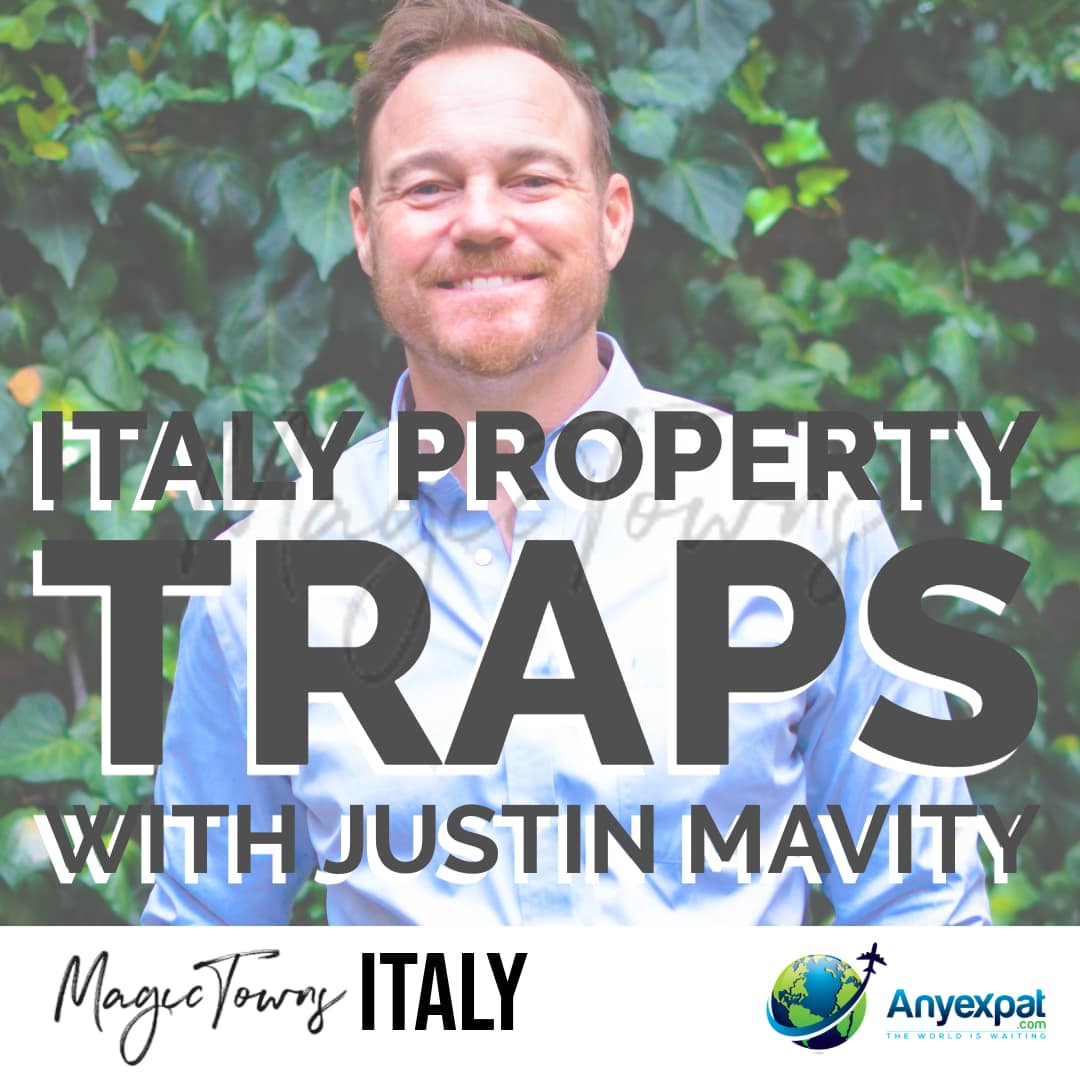

Property in Italy Traps: An Interview With Realtor Justin Curtis Mavity

March 28, 2026 00:20:15
Property in Italy Traps: An Interview With Realtor Justin Curtis Mavity
Magic Towns Italy
Property in Italy Traps: An Interview With Realtor Justin Curtis Mavity

Mar 28 2026 | 00:20:15

/

Hosted By

Miles Alessia

Show Notes

Luca: Happy Saturday everyone. Welcome back to the Magic Towns Italy podcast

This week we have a special guest. Justin Curtis Mavity. He’s been a real estate agent, one of the very few qualified, licensed, real estate agents from America in Italy.

After 10 years in the country, he has a lot to say about buying a property, which areas to pick, which areas to avoid. You can just hear straight in his words now.

Nice to meet you Justin.

Justin: You as well. Luca.

Luca: I think it would be interesting to start from how you got to Italy.

Justin: In 2017. I had been a teacher for about 15 years. I was a music teacher, in a public middle school in a suburb of Denver. And I’d always had this love of Italy. I’d been on several vacations before, and in fact, that’s how I discovered Bologna. We [00:01:00] stopped in Bologna and I said, wow, this place is magic.

I studied Italian for a year, a whole year, and before I kind of started getting my feet under the ground and I could be, you know, functional.

In Italy,

Luca: Did you have a network or did you just pick Bologna because you liked it when you visited? Uh,

Justin: In Denver we have an Italian friend, Lucia, who is from Bologna. And so that was, uh, that was the connection. At least there was somebody, uh, that I could reach out to in case of, emergency.

Luca: So you’ve been there for the best part of 10 years?

Justin: Yeah. For the best part of 10 years. It’s changed quite a lot, honestly. I mean, when I first came to Bologna, it was. It was a touristy city in the summer, of course, but not as much as Florence or Rome or Milan in the last few years, especially after COVID tourism here has exploded.

It’s, it’s noticeable. And then of course, you know, May and July are just, just chaos if you’re in Piazza Maggiore at this point. Yeah,

Luca: That still doesn’t explain how you got into real estate here, right?

Justin: So, real estate in the United States was always going to be my backup plan, my, my second career, I started so [00:02:00] young, I could have retired at 52. Uh, I’m gonna be 45 this year.

Luca: Go 81.

Justin: Yeah, go 81. Exactly. After I got my feet on the ground here, I, of course had to do the, the teaching English thing like many of us do, you know, to get by and to feed yourself and to pay the rent.

That was a several years long process just to even get into the real estate course here and get started. It was already something that was in my mind to do. And so when I came here, I thought, gosh, this is a supernatural fit. I mean, I’m an American. This is something I wanted to do. There is nobody basically doing this here that I know of.

Luca: Huge gap.

Justin: Yeah, absolutely.

I got my real estate license in the spring in May of 2023. And I’m sure you guys are a bit familiar with this process, that you have to do the, the written multiple choice exam and if you pass that, then you need to go onto this oral exam in front of a panel of experts and a live audience.

I passed that and I thought, gosh, I’m gonna get picked up by, by anybody. So I went to all the big agencies in town and they’re like, you can answer phones and do translations.

Luca: Really? [00:03:00]

Justin: Wow. That’s all. That’s all we can do with you. And then you can work.

But I did find a small local agency. They didn’t quite know what to do with me either, but at least they trained me and supported me with what I wanted to do. I kind of felt ready to go out on my own at that point.

Luca: But you survived.

Justin: I did survive.

I know, but there’s, as far as I know, here in Bologna, there’s no one else that has a license that’s doing what I’m doing.

Luca: Plenty of people without a license.

Yeah, of course. Course. Especially expats.

Justin: Oh yeah, exactly.

Luca: How do you feel about that?

Justin: You can get fined for doing this illegally if you get caught. And in theory, after the third time you can go to jail. No one goes to jail. The danger for a client in this and working with one of these people, my license and my insurance is a guarantee for you, right?

So if I do something bad that hurts your transaction, you have recourse against me.

You chose to work with somebody who’s unlicensed. You have no recourse. You have no way to protect yourself.

Luca: I was curious if you still [00:04:00] specialize in Bologna itself, or you’ve kind of gone countrywide,

Justin: I’ll go all the way down to Puglia and I will work throughout the country. There are areas that I tend to avoid.

I’m not a huge fan of going to Sicily, Rome is its own particular animal when it comes to real estate as well.

Luca: What kind of clients do you get and do these people know generally anything about Italy before telling you I want to find a house by the lake?

Justin: So I’m really clear with clients and say, you know, what are you looking for and where do you want it to be? And it’s really critical first that they have that where identified. Because Italy is very big and vastly different from city to city to region. I mean, nothing is the same.

And so if they don’t have that in their head and they say, well, Justin, I want a house by a lake. Well, there’s a lot of lakes in Italy that are, one is quite different from the other. And the other thing I tell them is you need to have been there first. If I’m going to work with you, if you are going to be looking in Como. Have you been to Como? Do you think you’re going to like Como? Or are you just [00:05:00] buying Como? Because that happens

Luca: a lot though.

Justin: Yeah. That happens a lot.

Luca: At that point you start holding their hands. They have been to, they have seen George Clooney Villa, and they want the one next door.

Justin: I work very collaboratively with my clients where I put together a spreadsheet and we all add things to it, you know, so they’re adding things, I’m adding things to it.

It’s a big process of elimination. I want them to feel like what they’re seeing is worth their time to see and not just something that I’ve put together for them.

Gillian: I think we’ve been on the tail end of that where you are with an agent who wants to show the seller that they’ve done the work. So they’re taking you to completely inappropriate properties just to put someone through the front door for the sellers.

Luca: Hey, I’m doing my job. I brought you two buyers.

Justin: Yeah, exactly. Yeah. Look, and they’re foreigners too. I told you I’d bring foreigners to your property. I promised you that right?.

Luca: What do you find the major differences to be between the US system and the Italian system?

Justin: Where do we start?

Luca: We have three [00:06:00] hours. Just on the property side

Justin: Everybody comments on the fact that a property inspection, like we have the United States, doesn’t exist. You can have an electrician come out, you can have a plumber come out, you can have a roofer come out, and you can get a general sense of the house in that way. But there’s no, I’m selling my property and I’m going to have the whole property inspected.

That doesn’t work here. If we want that kind of service, we really are gonna have to provide for that generally on our own.

Another big thing, people find it really strange that they’re required to make an offer and give earnest money immediately and often, uh, you know, people expect that as a seller, they expect that in their hands, but a good agent’s not going to let let that happen.

They’re gonna make that money go to the notary anyhow, which is what I do for my clients.

It’s always going to the notary, even if it costs you a little bit of money to hold it in there with the notary, well worth the protection if the deal falls apart.

Gillian: For example, in England, when you purchase a property, you have to do all the due diligence before the exchange happens, and that can typically take up to four months and then [00:07:00] you could lose it last minute or something can go wrong.

Whereas I, Italy, it’s, it’s much quicker.

Justin: It’s funny that you say that, Gillian, because again I worked with in, uh, Assisi in December with clients from the UK and they explained that to me that the deal can fall through. Even the day that you’re supposed to close, that the sellers can just walk away and say, no, I wanna sell it to somebody else.

Gillian: Correct.

Justin: That’s wild to me. One thing I I disagree with you on though, is the speed. Many of my clients are from the United States, not all but many are, and they’re surprised by how slow it is. Here. So they’re on the opposite side of that and they’re saying, wait, you know, I’m a cash buyer. What do you mean it’s gonna take four months to close? Five months to close.

Luca: It depends a lot on the property itself. I’ve seen properties close in days. And I’ve seen, I mean, we’re on, we’re on a contract now for a property for, what, two years, and it has been extended for another two years.

But it’s the beauty Italian system, I think.

Justin: Yeah.

Luca: Yeah. Because the notary will not, the notary is a very good friend of yours as a buyer.

Justin: [00:08:00] The notary works for you as the buyer. That’s the key thing.

Luca: In fact, a great thing you can do is get the offer accepted. With the knowledge that then the notary will throw every spanner in the works that they absolutely can to get everything spick and span.

Justin: But this is another thing that’s different from, you know, in, in Italy than in other countries. A lot of other countries, the settlers already going to have done. All of this work before putting the property on the market, or at least be really aware of what’s coming up in many, many other countries. I feel like sellers are generally much more prepared to sell the property than they are here.

Gillian: Maybe you have a different experience, but I also find that sold, vacant, and you know, they literally left clothes in the wardrobe, like.

Justin: One key element of of that of course, is to insert that there’s going to be an inspection walkthrough the day of or the day before the closing. With everybody present.

But that property in Assisi that happened, we had stipulated everything’s gonna be empty, everything’s gonna be cleaned out, ready to go. And we got there and all the store rooms were just full of junk still, you know, garbage broken [00:09:00] exercise bikes. And so the notary withheld, you know, 10,000 euros and said, I’m holding this money until you fulfill the obligations in the contract here.

You asked me something I wanna go back to as well. You asked me am I still a specialist in Bologna?

I work less in Bologna than I do outside of Bologna by far. I think that renting and buying here in Bologna have become so expensive in the last few years, and that’s really chasing people away.

Luca: I’m very keen to understand from you where you see, areas of opportunity.

Justin: I think Northern Tuscany. Is a very undiscovered area except for Lucca. I feel like Lucca is almost like going to Disneyland at this point. I go and there are American families pushing kids in strollers. I only hear English being spoken on the street.

Luca: But the Lunigiana, I think is what you’re referring to.

Justin: Exactly. Really beautiful. You can buy wonderful houses made of stone in these little villages that are walk-in only for like 30,000, 40,000 euros.

Luca: Has an interesting history because it, it used to be a very poor area [00:10:00] and it is also may surprise you the rainiest area of Italy. So you’re not going there for the sun necessarily? No. But with the global warming. I don’t think that’s necessarily a bad idea. When you go there in the summer, it’s like, oh, this is actually nice

Justin: it’s really pleasant. Another area, and I have to, you know, put a shout out to my home area here. Bologna is its own thing, but the Bolognese Appennines and Modenese Appenines and that area, you can still buy again, really gorgeous properties, stone villas, farmhouses, whatever you want for really reasonable prices.

The hills are a little different than, you know, Sienna. We’re not talking about that rolling, undulating, uh, lovely greenery, but it’s still absolutely stunning. Opportunities left and right. No one knows about that area yet.

Luca: No, of course not. And they are areas where the depopulation has been massive, uh, in the past 30, 40 years, and therefore people are desperate to get rid of the [00:11:00] grandparents’ house.

Yeah. But that doesn’t mean that they’re not beautiful. In fact, as you say. Maybe if you got some of the Tuscan crowd over there, they might struggle to see the difference. I often say to people that if you blindfold them, you take them around Italy and you say, this is Tuscany, they’ll be like, yeah, I can see that.

That’s Tuscany. Yeah, that’s not Tuscany.

Justin: It’s not Tuscany. Yeah, exactly.

Luca: Yeah. Except take a zero off the selling price and then you see how the, you know how the reality is different.

Justin: The other thing about this area too, over here near Bologna is that of course we’re really well connected. You know, we have, uh, the airport in Bologna, which has a zillion flights coming in, out, in and out every day. The train station in Bologna, of course, is a major hub, uh, for trains all throughout Italy that are going north and south. So, I mean, for anybody arriving. It’s a great place to start out.

Luca: It is for the taking for the people that take the time to get out of the beaten track. I hope that we get more and more of the, you know, the foreign crowd to go and explore and, uh, try to revitalize these places, which frankly need it. We don’t need as [00:12:00] many 2 million euro sold in Tuscany. We need more of the a hundred thousand farmhouses in Emilia Romagna sold,

Justin: Exactly. We wanna re revitalize and maintain, you know, the culture in these areas. That’s really, really important.

Anna: I just have a question, I’m talking about people that have never been to Italy, and then just have the idea in their mind and realize later that that’s not like the right place for them.

Justin: Well, I think it’s kind of wherever the “in” place is at the moment.

You’re probably following these trends on social media. I mean, I feel like Puglia, these last couple years has really been all over social media, but people get in to Puglia and it’s, yeah, it’s gorgeous. It is really a wonderful place.

But if you’re moving down there to live full-time, you really have to be knowing what you’re getting into and the area you’re buying into. One of my colleagues was recently talking to a family, an American family who fell into this trap in Puglia, bought in some little village, a really gorgeous house, you know, of course made of stone and wonderful. And they [00:13:00] paid nothing but. They said, we have to get out of here. It’s, it is wonderful if you’re vacationing perhaps, but to live here full time, in the winter there’s nothing going on. We find the people kind of closed off. It doesn’t have all the services that we want. And so, they, to go back to your question, they kind of get sucked into whatever this social media trap is at the moment or whatever the big publicity is at the moment, so now it’s Puglia, the last couple previously, of course it was Tuscany and Umbria. And of course the, they still kind of also dominate. Who knows what will be next. I see Sardinia popping up a lot, uh, recently, and you know, people are gonna get sucked into that trap as well, you know. Yes. Living in Sardinia would be wonderful. I mean, we just, we spent, several weeks in, in Sardinia last summer. It was great. Would I have wanted to live there all year round in December, January, February, with nobody around, no services?

These stereotypes only show the positives. You know, that’s all that people are getting is they don’t get the reality of these places.

Luca: We talked a lot about buying. But a lot of people come here wanting to rent [00:14:00] and they know from experience what a cultural shock that is. Can you tell us a little bit about the foreign perspective of what it’s like to actually find someone to rent?

Justin: Yeah. Boy, that was a challenge for me 10 years ago, and now it’s gotten even more challenging. It’s not like in the, in many countries where if I go into a rental agency or even meet a landlord for a property and I have a wad of cash, I can just kind of throw that wad of cash at them and I’m probably going to get the apartment, this happens a lot in the United States.

Of course they’re gonna let me sign a rental contract and pay money up front. Italy doesn’t work like that because of course we have a lot of tenants protections, tenants rights. You put somebody in that property with a registered contract and it is really hard, as we all know.

It’s easier to divorce, it’s easier to divorce than it is to get the tenants out of your property. And so property owners are really leery about this. And then of course, we have this mafia history. So you show up with this giant bag of cash. You say, I can pay you 10,000 euros [00:15:00] today. What are these landlords supposed to be thinking?

Italy doesn’t work like that. You really have to demonstrate your value as a tenant.

So again, you have to have a job and that you have income coming in. You hopefully have a letter of presentation from that company that explains what you do and how much money you make.

You have to show a tax return. They need to see that you have consistent income coming in. Wherever it’s from, it’s not what you have some value to offer to the landlord. You have to present yourself in the best, most secure way possible.

Luca: It’s like a job interview in

Justin: a way.

Luca: Yes.

Justin: Landlords will let their property sit vacant rather than put the wrong tenant in a property, right? Because they don’t wanna risk putting the wrong person in there who stops paying.

Luca: Changing, I feel a little bit with these, uh, transitory, like, you know, the up to one year contracts.

So there seems to be a little bit more flexibility because people feel like, uh, if they put a tenant down as a tourist, that the tenant loses a lot of the protections under the law, whether they that is actually [00:16:00] enforceable or not. Yeah. Well that’s,

Justin: yeah.

Luca: There’s still the issue of the furniture.

Meaning that you do find eventually this apartment, then you find that you have to bring not only all the furniture, but very often even the kitchen. And that is shocking.

Justin: That’s not, not so much the case anymore. I’ve found, and again, I, and I, I mentioned this to everybody. That’s very uncommon anymore that you find an apartment with, nothing.

I think that here in this area, it’s more common to find in furnishings included of some kind, at least a kitchen, you know, maybe also a washing machine, maybe also some general furniture of the house. Um, but that is surprising when people see that they say, wait a second, it says fully furnished, but maybe it doesn’t literally have every single thing. That you can think of, you know, maybe it’s fully furnished and it has a, you know, kitchen table and chairs or dining room table chairs and a bed in each room and a wardrobe in each room. And that’s really about it.

Other thing about security that landlords want is they want somebody who’s going to be in there paying rent on time, and they want somebody who’s gonna be in there paying rent on time for a long time, right?

They want that income [00:17:00] year after year. So here, at least in my area, they’re looking for, you know, traditional four plus four or three plus two contracts, uh, with tenants. Do

Luca: you find that people are surprised that when they come to Italy and they find that renting generally means, uh, hey, I’m signing a contract for three or four years?

Justin: Yes, I do my best to explain this to ’em, of course, upfront and say, you know, generally there’s going to be a, an escape clause of three months, you know, for whatever reason for you, you know, we’re gonna try on our best to make sure that happens. And there, and as you know, there has to be an escape clause anyhow in the contract.

So you have to do a little preparation and understand. Yeah, it seems scary. I could be locked into this thing for eight years, but yeah, that’s an eight year contract that I can break anytime with three months notice, so that becomes way less scary.

Luca: I assume you have to run.

Justin: Yes. I should probably go even though I’m really enjoying myself and I could keep talking for hours.

Luca: We’d happy to do a follow up.

Justin: I always see these articles on CNN about how wonderful it is to move to Italy and buy your one euro home and renovate it and look how, you know, how happy this 75-year-old [00:18:00] couple is that, you know, it’s just what

Luca: That is one great story because we were talking last week about this woman we met in a one euro home town. She was like, like the one I you mentioned before in Puglia. Get me out of it. Get me out.

Justin: What is there to do there?

Luca: There’s a reason why they can’t sell the homes, but then again, if they sell enough of those homes, they

Anna: fix that

Luca: if it fixes the problem. So

Justin: it does, it does. It really depends on the village though, doesn’t it?

It has to be just the right village and just the right place. With just enough level of services. I, it’s one in a

Luca: thousand.

Justin: Yeah. A lot of these villages really have nothing. They have nothing. It’s just a glob of houses, a collection of houses, ruined houses. It doesn’t even have the post office. Right. What attraction is there?

Luca: We hope to talk to you soon again.

Luca: Thanks to Justin. It was great fun to have him. We’ll be back for part two with him. What do you think, Gill? You’ve spoken to him a couple times.

Gillian: I thought he was fantastic. People have lives and varied requirements and people want different things and he [00:19:00] seems to, to understand that.

Luca: Yeah. And we certainly understand that. After all, that’s what we do. Try to highlight a huge country in all its multifaceted variety.

Gillian: One thing I thought you said that was very interesting was doing your research and doing your homework before you, you know, outta the blue turn up and say, I want a house in.

Luca: Tuscany.

Gillian: Yeah. Tuscany.

Luca: Yeah. Don’t call from Antarctica and say you wanna move to Tuscany if you haven’t been there because, uh, well at least don’t call Justin because he might not like that. I hope you have a fantastic weekend.

Gillian: Thank you guys.
Was this helpful?

✅ Yes
❌ No
Submit Cancel
Thanks for your feedback!
View Full Transcript

Episode Transcript

[00:00:00] Speaker A: Foreign [00:00:04] Speaker B: in Italy. And you're listening to the Magic Towns Italy podcast. [00:00:08] Speaker C: Happy Saturday everyone. Welcome back to the Magic Towns Italy podcast. This week we have a special guest, Justin Curtis Mavati. He's been a real estate agent, one of the very few qualified licensed real estate agents from America in Italy. After 10 years in the country, he has a lot to say about buying a property. Which areas to pick, which areas to avoid. You can just hear straight in his words now. Nice to meet you, Justin. [00:00:41] Speaker D: You as well, Luca. [00:00:42] Speaker C: I think it would be interesting to [00:00:43] Speaker D: start from how you got to it in 2017. I had been a teacher for about 15 years. I was a music teacher in a public middle school in a suburb of Denver. And I'd always had this love of Italy. I'd been on several vacations before and in fact, that's how I discovered Bologna. We stopped in Bologna and I said, wow, this place is magic. I studied Italian for a year, a whole year before I kind of started getting my feet under the ground and I could be, you know, functional in Italy. [00:01:10] Speaker C: Do you have a network or did you just pick Bologna because you liked it when you visited? [00:01:14] Speaker D: In Denver, we have an Italian friend, Lucia, who is from Bologna. And so that was, that was the connections. At least there was somebody that I could reach out to in case of emergency. [00:01:26] Speaker C: So you've been there for the best part of 10 years? [00:01:29] Speaker D: Yeah, for the best part of 10 years. It's changed quite a lot, honestly. I mean, when I first came to Bologna, it was, it was a touristy city in the summer, of course, but not as much as Florence or Rome or Milan. In the last few years, especially after Covid tourism here has exploded, but it's, it's noticeable. And then of course, you know, May and July are just, just chaos if you're in Piazza Majority. [00:01:48] Speaker C: And at this point, that still doesn't explain how you go into real estate here. Right. [00:01:53] Speaker D: So real estate in the United States was always going to be my backup plan. My, my second career. I started so young I could have retired at 52. I'm going to be 45 this year. [00:02:03] Speaker C: Go 81. [00:02:04] Speaker D: Yeah, go 81. Exactly. After I got my feet on the ground here, I of course had to do the, the teaching English thing like many of us do, you know, to get by and to feed yourself and to pay the rent. That was a several years long process just to even get into the real estate course here and, and get started. It was already something that was in my mind to do. And so when I came here, I thought Gosh, this is a supernatural fit. I mean, I'm an American. This is something I wanted to do. There is nobody basically doing this here that I know of. [00:02:31] Speaker C: Hughes Gap. [00:02:32] Speaker D: Yeah, absolutely. I got my real estate license in the spring, in May of 2023. And I'm sure you guys are a bit familiar with this process. You have to do the, the written multiple choice exam. And if you pass that, then you need to go onto this oral exam in front of a panel of experts and a live audience. I passed that and I thought, gosh, I'm going to get picked up by, by anybody. So I went to all the big agencies in town and they're like, you can answer phones and do translations. Wow, that's all, that's all we can do with you. And then you can work. But I did find a small local agency. They didn't quite know what to do with me either, but at least they trained me and supported me with what I wanted to do. I kind of felt ready to go out on my own at that point. [00:03:15] Speaker C: But you survived. [00:03:16] Speaker D: I did survive. I know, but there's, as far as I know, here in Bologna, there's no one else that has a license that's doing what I'm doing. [00:03:25] Speaker C: Plenty of people without a license. Yes, Expats. [00:03:28] Speaker D: Oh, yeah, exactly. [00:03:29] Speaker C: How do you feel about that? [00:03:30] Speaker D: You can get fined for doing this illegally if you get caught, and in theory, after the third time, you can go to jail. No one goes to jail. The danger for a client in this and working with one of these people, My license and my insurance is a guarantee for you. Right. So if I do something bad that hurts your transaction, you have recourse against me. Right. You chose to work with somebody who's unlicensed. You have no recourse. You have no way to protect yourself. [00:03:57] Speaker C: I was curious if you still specialize in Bologna itself or you've kind of gone country wide. [00:04:04] Speaker D: I'll go all the way down to Puglia and I will work throughout the country. There are areas that I tend to avoid. I'm not a huge fan of going to Sicily. Rome is its own particular animal when it comes to real estate as well. [00:04:17] Speaker C: What kind of clients do you get? Do these people know generally anything about Italy before telling you? I want to find the housewar, so [00:04:24] Speaker D: I'm really clear with clients and say, you know, what are you looking for and where do you want it to be? And it's really critical first that they have that where identified because Italy is very big and vastly different from city to city. To region. I mean, nothing is the same. And so if they don't have that in their head and they say, well, Justin, I want a house by a lake. Well, there's a lot of lakes in Italy that are. One is quite different from the other. And the other thing I tell them is, you need to have been there first if I'm going to work with you. If you're going to be looking in Como. Have you been to Como? Do you think you're going to like Como or are you just buying Como? [00:05:01] Speaker C: That happens a lot, though. [00:05:02] Speaker D: Yeah, that happens a lot. [00:05:03] Speaker C: At that point, you'd start rolling their hands. They have been to Lake. Com. They have seen Joel Cly's villa, and they want the one next door. [00:05:09] Speaker D: Okay. I work very collaboratively with my clients where I put together a spreadsheet and we all add things to it, you know, so they're adding things, I'm adding things to it. It's a big process of elimination because I want them to feel like what they're seeing is worth their time to see and not just something that I put together for them. [00:05:30] Speaker A: I think we've been on the tail end of that, where you were with an agent who wants to show the seller that they've done the work. So they're taking you to completely inappropriate properties just to put someone through the front door for the sellers. [00:05:42] Speaker C: Hey, I'm doing my job. I brought in two likely buyers. [00:05:45] Speaker D: Yeah, exactly. Look. And they're foreigners, too. I told you I'd bring foreigners to your property. I promised you that. Right. [00:05:51] Speaker C: What do you find the major differences to be between the US System and the Italian system? [00:05:57] Speaker D: Where do we start? [00:06:01] Speaker C: Just on the property side. [00:06:02] Speaker D: Everybody comments on the fact that a property inspection like we have the United States doesn't exist. You can have an electrician come out, you can have a plumber come out, you can have a roofer come out, and you can get a general sense of the house in that way. But there's no. I'm selling my property and I'm going to have the whole property inspected. Yeah, that doesn't work here. If we want that kind of service, we really are going to have to provide for that generally on our own. Another big thing, people find it really strange that they're required to make an offer and give earnest money immediately. And often, you know, people expect that as a seller. They expect that in their hands. But a good agent's not going to let you know that happen. They're going to make that money go to the notary. Anyhow, which is what I do for my clients. It's always going to the notary. Even if it costs you a little bit of money to hold it in there with the notary. Well worth the protection if the deal falls apart. [00:06:51] Speaker A: For example, in England, when you purchase the property, you have to do all the due diligence before the exchange happens, and that can typically take up to four months, and then you could lose it last minute or something can go wrong. Whereas in Italy, it's much quicker. [00:07:05] Speaker D: It's funny that you say that, Gillian, because again, I worked in Assisi in December with clients from the UK and they explained that to me that the deal can fall through even the day that you're supposed to close, that the sellers can just walk away and say, no, I want to sell it to somebody else. [00:07:19] Speaker A: Correct. [00:07:20] Speaker D: That's wild to me. One thing I disagree with you on, though, is the speed. Many of my clients are from the United States, not all, but many are, and they're surprised by how slow it is here. So they're on the opposite side of that and they're saying, wait, you know, I'm a cash buyer. What do you mean it's going to take four months to close, five months to close? [00:07:38] Speaker C: It depends a lot on the property itself. I've seen properties close in days and I've seen. I mean, we're on. We're on a contract now for a property for what, two years? For other two years. That's the beauty of the Italian system, I think. [00:07:54] Speaker D: Yeah. [00:07:55] Speaker C: Because the notary would not. The notary is a very good friend of yours as a buyer. [00:07:59] Speaker D: The notary works for you as the buyer. That's the key thing, is that a [00:08:02] Speaker C: great thing you can do is get the offer accepted with the knowledge that then the notary will throw every spanner in the works that they absolutely can to get everything spick and Spanish. [00:08:13] Speaker D: But this is another thing that's different from, you know, in Italy than in other countries. A lot of other countries, the seller's already going to have done all of this work before putting the property on the market, or at least be really aware of what's coming up in many, many other countries. I feel like sellers are generally much more prepared to sell the property than they are here. [00:08:33] Speaker A: Maybe you have a different experience. But I also find that sold vacant and, you know, they literally left clothes in the wardrobe. [00:08:39] Speaker D: Like, one key element of that, of course, is to insert that. There's going to be an inspection walkthrough the day of or the day before. The closing with everybody present. But that property in Assisi that happened, we had stipulated everything's going to be empty, everything's going to be cleaned out, ready to go. We got there and all the storerooms were just full of junk still, you know, garbage, broken exercise bikes. And so the notary withheld, you know, €10,000 and said, I'm holding this money until you fulfill the obligations in the contract here. You asked me something I want to go back to as well. Ask me, am I still a specialist in Bologna? I work less in Bologna than I do outside of Bologna by far. I think that renting and buying here in Bologna have become so expensive in the last few years, and that's really chasing people away. [00:09:24] Speaker C: I'm very keen to understand from you where you see areas of opportunity. [00:09:29] Speaker D: I think northern Tuscany is a very undiscovered area, except for Lucca. Yeah, I feel like Luca is almost like going to Disneyland at this point. I go and there are American families pushing kids in strollers. I only hear English being spoken on the street. [00:09:43] Speaker C: The Rumigana, I think, is what you're referring to. [00:09:46] Speaker D: Exactly. Really beautiful. You can buy wonderful houses made of stone in these little villages that are walk in only for like 30,000, €40,000. [00:09:56] Speaker C: That's an interesting history, because it used to be a very poor area. And it is also, may surprise you, the rainiest area of Italy. So you're not going there for the sun necessarily? No, with the global warming, I don't think that's necessarily a bad idea. When you go there in the summer, [00:10:13] Speaker D: it's like, oh, this is actually nice, it's really pleasant. Another area. And I have to, you know, put a shout out to my home area here. Bologna is its own thing, but the Bolognese Apennines and the Modenese Apennines and that area you can still buy, again, really gorgeous properties, stone villas, farmhouses, whatever you want for really reasonable price. The hills are a little different than, you know, Sienna. We're not talking about that rolling, undulating, lovely greenery, but it's still absolutely stunning opportunities left and right. No one knows about that area yet. [00:10:49] Speaker C: No, of course not. And they are areas where the population has been massive in the past few, 30, 40 years. And therefore people are desperate to get rid of the grandparents house. Yeah, but that doesn't mean that they're not beautiful. In fact, as you say, maybe if you got some of the Tuscan crowd over there, they might struggle to see the difference. It's often saying to people that if you blindfold them you take them around Italy, you say, this is Tuscany, they'll be like, yeah, I can see that. That's Tuscany. [00:11:15] Speaker D: Yeah. [00:11:15] Speaker C: That's not Tuscany. [00:11:16] Speaker D: It's not Tuscany. Yeah, exactly. [00:11:17] Speaker C: Except take a zero of the sodium price, and then you see how, you know, how the reality is different. [00:11:23] Speaker D: The other thing about this area, too, over here near Bologna, is that, of course, we're really well connected. You know, we have the airport in Bologna, which has a zillion flights coming in out, in and out every day. The train station in Bologna, of course, is a major hub for trains all throughout Italy that are going north and south. So, I mean, for anybody arriving, it's a great place to start out. [00:11:43] Speaker C: It is for the taking, for the people that take the time to get out of the beaten track. I hope that we get more and more of the, you know, the foreign crowd that you go and explore and try to revitalize this place, which, frankly, needed. We don't need as many 2 million Eurovidas sold in Tuscany. We need more than a hundred thousand farmhouses in Media Romania, so. [00:12:06] Speaker D: Exactly. We want to revitalize and maintain the culture in these areas. That's really, really important. [00:12:12] Speaker A: I just have a question. I'm talking about people that. [00:12:15] Speaker D: I've never been to Italy, and then [00:12:17] Speaker A: just have that idea in their mind [00:12:20] Speaker D: and realize later that that's not, like, the right place for them. Well, I think it's kind of wherever the in place is at the moment. You're probably following these trends on social media. I mean, I feel like Puglia these last couple years has really been all over social media. But people get in to Puglia and it's. Yeah, it's gorgeous. It is really a wonderful place. But if you're moving down there to live full time, you really have to be knowing what you're getting into and the area you're buying into. One of my colleagues was recently talking to a family, an American family who fell into this trap in Puglia, bought in some little village a really gorgeous house, you know, of course, made of stone and wonderful. And they paid nothing, but they said, we have to get out of here. It's. It is wonderful if you're vacationing, perhaps, but to live here full time in the winter, there's nothing going on. We find the people kind of closed off. It doesn't have all the services that we want. And so they. To go back to your question, they kind of get sucked into whatever this social media trap is at the moment or whatever the big publicity is at the moment. So now it's Puglia, Alaska. Previously, of course, it was Tuscany and Umbria, and of course they still kind of also dominate. Who knows what will be next. I see Sardinia popping up a lot recently, and, you know, people are going to get sucked into that trap as well, you know? Yes, living in Sardinia would be wonderful. I mean, we just, we spent several weeks in Sardinia last summer. It was great. Would I have wanted to live there all year round in December, January, February with nobody around, no services? These stereotypes only show the positives. You know, that's all the people are getting is they don't get the reality of these places. [00:13:55] Speaker C: We talked a lot about buying, but a lot of people come here, wanted to rent. And I know from experience what a cultural shock that is. Can you tell us a little bit about the foreign perspective of what it's like to actually find someone to rent? [00:14:09] Speaker D: Yeah. Boy, that was a challenge for me 10 years ago, and now it's gotten even more challenging. You know, it's not like in the. In many countries where if I go into a rental agency or even meet a landlord for a property and I have a wad of cash, I can just kind of throw that wad of cash at them and I'm probably going to get the apartment. This happens a lot in the United States. Of course, they're going to let me sign a rental contract and pay money up front. Italy doesn't work like that because, of course, we have a lot of tenants protections, tenants rights. You put somebody in that property with a registered contract and it is really hard. As we all know, it's easier to divorce than it is to get the tenants out of your property. And so property owners are really leery about this. And then of course, we have this mafia history. So you show up with this giant bag of cash, you know, and you say, I can pay you €10,000 today. What are these landlords supposed to be thinking? Italy doesn't work like that. You really have to demonstrate your value as a tenant. So again, you. You have to have a job and that you have income coming in. You hopefully have a letter of presentation from that company that explains what you do and how much money you make. You have to show a tax return and you to see that you have consistent income coming in wherever it's from. So that way you have some value to offer to the landlord. You have to present yourself in the best, most secure way possible. [00:15:29] Speaker C: It's like a job interview, in a way. [00:15:31] Speaker D: Landlords will let their property sit vacant rather than put the wrong tenant In a property. Right. Because they don't want to risk putting the wrong person in there who stops paying. [00:15:42] Speaker C: Changing. I feel a little bit with these transitory, like, you know, the up to one year contracts, this seems to be a little bit more flexibility because people feel like if they put a tenant down as a tourist, that the tenant loses a lot of the protections under the law, whether that is actually enforceable or not. [00:16:00] Speaker D: Yeah. [00:16:01] Speaker C: There's still the issue of the furniture. Meaning that you do find eventually this apartment, then you find that you have to bring not only all the furniture, very often, even the kitchen. And that is shocking. [00:16:12] Speaker D: That's not so much the case anymore. I found, and again, I, and I mentioned this to everybody. It's very uncommon anymore that you find an apartment with nothing. I think that here in this area it's more common to finding furnishings included of some kind. At least a kitchen, you know, maybe also a washing machine, maybe also some general furniture of the house. Um, but that is surprising when people see that. They say, wait a second, it says fully furnished, but maybe it doesn't literally have every single thing that you can think of. You know, maybe it's fully furnished and it has a, you know, kitchen table and chairs or dining room table, chairs and a bed in each room and a wardrobe at each room. And that's really about it. The other thing about security that landlords want is they want somebody who's going to be in there paying rent on time and they want somebody who's going to be in there paying rent on time for a long time. Right. They want that income year after year. So here, at least in my area, they're looking for, you know, traditional four plus four or three plus two contracts with tenants. [00:17:08] Speaker C: Do you find that people are surprised that when they come to a. They find that the ranking generally means, hey, I'm signing a contract for three or four years. [00:17:16] Speaker D: Yes. I do my best to explain this to them, of course, upfront and say, you know, generally there's going to be an escape clause of three months, you know, for whatever reason for you, you know, we're going to try our best to make sure that happens in there. And as you know, there has to be an escape clause anyhow in the contract. So you have to do a little preparation and understand. Yeah, it seems scary. I could be locked into this thing for eight years, but yeah, that's an eight year contract that I can break any time with three months notice. So that becomes way less scary. [00:17:44] Speaker C: I assume you have to run. [00:17:45] Speaker D: Yes, I should probably go Even though I'm really enjoying myself and I could keep talking for hours. [00:17:50] Speaker C: Happy to do a follow up. [00:17:52] Speaker D: I always see these articles on CNN about how wonderful it is to move to Italy and buy your one year old home and renovate it. And look how, you know, how happy this 75 year old couple is that you know just what, that is one [00:18:03] Speaker C: great story because we were talking last week about this woman we met in a €1 home in town and she was like, like the woman you mentioned before in Puglia. Get me out of it, get me out. [00:18:14] Speaker D: What is there to do there? [00:18:16] Speaker C: There's a reason why they can't sell the homes, but then again, if they sell enough of those homes, if it fixes the problems. [00:18:24] Speaker D: It does, it does. It really depends on the village though, doesn't it? It has to be just the right village in just the right place with just enough level of service. [00:18:33] Speaker C: One in a thousand. [00:18:34] Speaker D: Yeah. A lot of these villages really have nothing, you know, they have nothing. It's just a glob of houses, a collection of houses, ruined houses. It doesn't even have the post office. Right. What attraction is there? [00:18:45] Speaker C: We hope to talk to you soon. Again, thanks to Justin. It was great fun to have him. We'll be back for part two with him. What do you think, Joe? You've spoken to him a couple of times. [00:18:54] Speaker A: I thought he was fantastic. People have large and varied requirements and people want different things and he seems to, to understand that. [00:19:02] Speaker C: Yeah, we certainly understand that. After all, that's what we do. So to highlight a huge country in all its multifaceted variety. [00:19:10] Speaker A: One thing I thought you said that was very interesting was doing your research and doing your homework before you, you know, out of the blue, turn up and say, I want a house in Tuscany. Yeah, Tuscany. [00:19:22] Speaker D: Yeah. [00:19:22] Speaker C: Don't call from Antarctica and say you want to move to Tuscany if you haven't been there because. Well, at least don't call Justin because he might not like that. I hope you have a fantastic weekend. [00:19:34] Speaker A: Thank you guys. [00:19:35] Speaker B: That's it for this week on MagicTowns Italy. You can create a free [email protected] and explore over 2,000 towns, including those offering the 7% tax scheme, as well as download dozens of expat guides. We have over 200 data points per town, more than Italy's statistics authority itself, covering everything from property prices to schools, healthcare, crime and more. If you want full access to filters and unlimited searches, upgrade to MagicTowns Premium. Use the code PODCAST for 20% off an annual plan. Thanks for listening. Our next podcast will be live on Saturday at 9:00am.

Other Episodes

Episode 0

June 21, 2025 00:22:15
Episode Cover

From Daydream To Dirty Hands: Could You Be A Farmer In Italy?

This podcast episode is heavily based on our guide on Farming in Italy. [00:00:11] Miles: Welcome back to Magic Towns Italy, the podcast with...

Listen

Episode

June 28, 2025 00:20:32
Episode Cover

Renovating in Italy: 10 Huge Mistakes To Avoid

[00:00:08] Miles: Welcome back listeners to the Magic Towns Italy podcast with Miles and Alessia. Today we’re diving headfirst into a dream, so many...

Listen

Episode

September 27, 2025 00:14:22
Episode Cover

Five Great Expats Towns in Sicily

[00:00:08] Miles: If you’re dreaming about retirement and that dream involves slow living, amazing scenery every day, maybe even a view of the sea,...

Listen