Hosted By
Luca: Happy Saturday to our listeners. We’re back with the Magic Towns Italy podcast. I am Luca
Anna: and Anna. Today we are heading back to one of the regions that often gets overlooked in conversations about moving to Italy, but really shouldn’t.
Luca: People go to Italy, they imagine I’m gonna go to Tuscany, Rome. Milan maybe Puglia, but Le Marche is off the radar for most people. And one of the things we like to do at Magic Towns is look a little bit further.
Anna: Yeah, absolutely. Because, you know, Le Marche have the sea, the mountains, beautiful towns, strong food culture. It’s a beautiful area. This area also feels more structured than most of Central Italy, and there are lots of towns that qualify for the [00:01:00] 7% tax scheme
Luca: of which you have spoken time and time and time again. You are the expert.
Anna: Yeah.
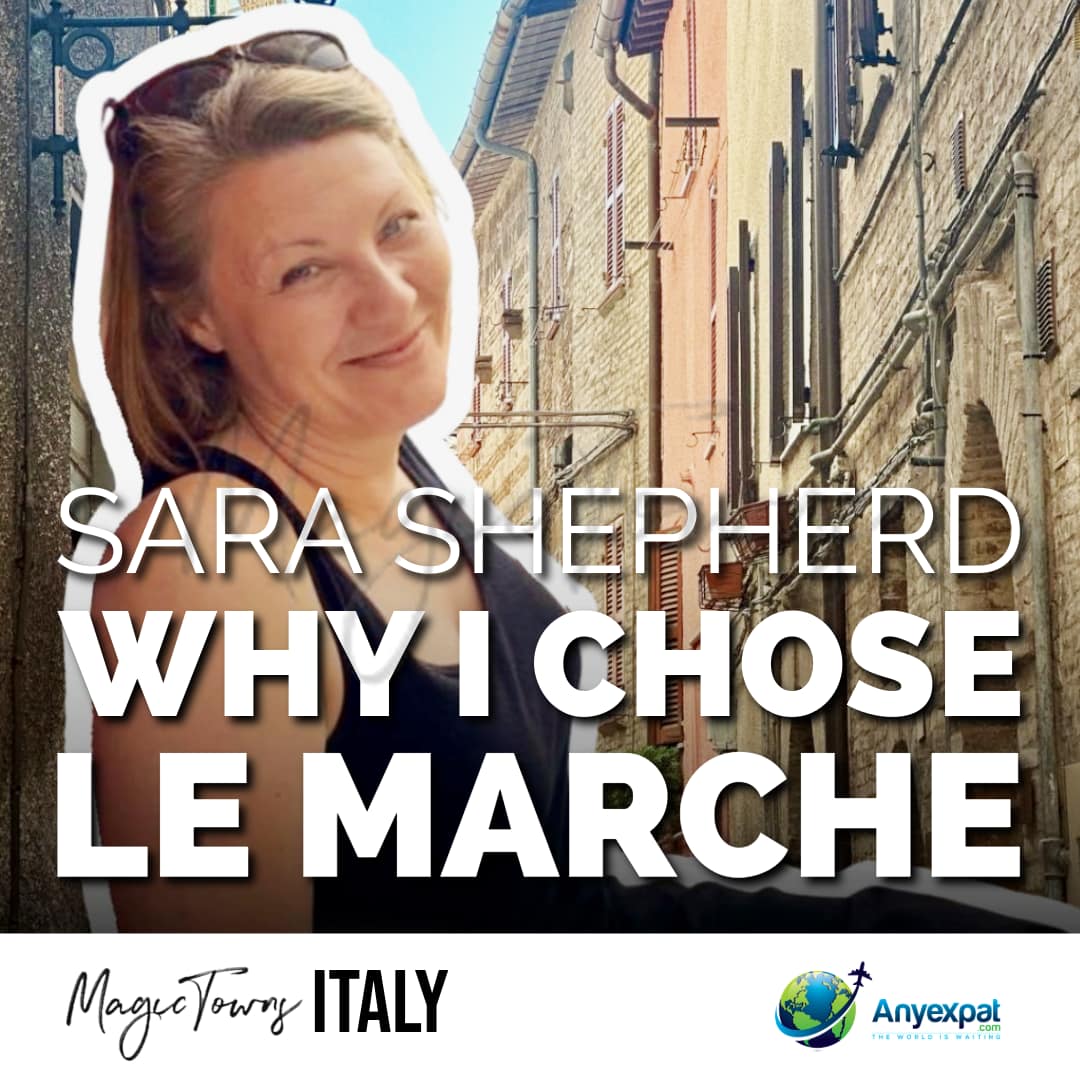
Luca: So today we’re going to discuss the process of settling down in the Marche through the voice of our guest, Sara.
Sarah is originally from Australia and she moved to Italy after what she , described as a bit of a midlife crisis. She came to Italy to study Gastronomic Sciences. I didn’t even know it was a thing before hearing it from her. And then she made the decision to stay in Italy and to build something of our own.
Anna: Yeah. You know what I liked about Sara’s story is that it isn’t random at all. Like she didn’t fall in love with a postcard and jump, she approached the move very thoughtfully. She had a spreadsheet criteria, a town size in mind, access to airports, access to trains, and then eventually she found herself in Fabriano.
Luca: I thoroughly [00:02:00] approve of that approach as you can imagine. And the property angle in talking to Sarah is interesting too. It’s not like she came, she bought a small apartment and settled down, or she took on a big renovation project and added to, into her background in food, hospitality and walking internationally, and she imagined a creative and community-based future for the property she was fixing up.
Anna: Yeah. So in this episode you’ll hear about why she choose the town of Fabriano, what surprised her about moving inland rather than to the coast, how she found the buying and renovation process in Italy, and also what she sees in Le Marche as a place for food tourism reason and as lower, more intentional travel.
Luca: So without further ado, here is Anna with Sara on living in the Marche.
Sara: I am from Australia and i’ve been living in Melbourne for most of my life, but I’m from a [00:03:00] small country town about the same size as Fabriano. And I’ve worked in the food industry all of my life. I suppose the kind of reason that I came to Italy was a bit of a midlife crisis because I’m 50 and I applied for the University of Gastronomic Science.
Anna: Mm-hmm.
Sara: Um, which is located in Bra in Piemonte, and it’s a university that was started by Carlo Petrini from the Slow Food movement. I was accepted. So I’ve done a Master’s of Food Communication and Marketing, and I decided to stay.
Anna: And then from Bra you moved to Le Marche.
Sara: Yeah, so I really enjoyed that year in Bra. The trains were amazing. I could get to Milan really easily and just as a right size town I think as well. So when I did start my kind of like, oh, maybe I’ll just move somewhere in Italy, look around, I had quite a detailed spreadsheet and some of the things on that list were [00:04:00] being quite close to a major capital.
So within two to three hours, was really important for me. Just in case I need to get home in a hurry, then that’s more possible. A 15 meter swimming pool was also on my list, but that wasn’t available, which is the shame.
The size of the town, I think 30, 40,000 people is a really nice size town.
Anna: So you made a sheet and how did it happen that you found Fabriano just looking around? Or did you know someone or
Sara: I know, the region a little bit, obviously because of the wine and food. I think because I studied food, I was already a little bit aware that I’ve spent a bit of time in Senigallia and Abruzzo so I kind of knew this coastline.
But not inland so much. But I thought not being on the coast was a good idea. I just wanted to be a little bit off the coast and I was with me in and Matelica and Fabriano, and in the end it was actually the property that made me decide on that. But also the town is really cute. [00:05:00] It’s not on top of a hill, like a traditional Italian town.
It’s a little bit in more of a valley, and there’s a beautiful river that runs through the town and my property backs onto the river, which is really amazing.
It was a really wealthy town, so there’s a lot of really beautiful old buildings and million churches as you would expect, and a really gorgeous theater.
Anna: And how was the process of finding the property? Did you speak Italian first?
Like finding professionals? Most of the time, the most difficult part.
Sara: How did I find the property? Chatting with different real estate agents online. And I just so happened to find a really great agent in Fabriano and they had a really fantastic team that are very organized.
Anna: Can you talk a bit more about this project, how the idea started, and what is your vision for the future?
So the property you’re talking about is Fritto Misto Comune, right?
Sara: I would’ve just bought an apartment for myself. But I’ve renovated some properties in Australia before, so I do enjoy that challenge. So when I was looking at houses [00:06:00] and this one came about, it was a bit of a project.
It’s actually a very big project. I suppose came about because when I was studying, some friends that I made in my class, one of them is Finnish and one of them is Canadian.
We were in the back of a taxi one night and the taxi driver said, wow, you are all speaking English, but they’re all different accents. Where are you from? And we told him, and then he said, oh, you’re like a fritto misto. And it just kind of stuck. I thought it was a great little name. Nothing to do with the fried food. Sorry.
Anna: Yeah. But also it’s connected with your passion for food.
Sara: Yeah. So i’ve done lots of little projects together and lots of my other friends from around the world have also had some input into the projects and I would like to continue.
It’s a bit of a community creative space, a really nice community of people.
Anna: How did you find the Italian market, the pros, the cons, the difficulties
Sara: I think I’ve been really lucky in the fact that I’ve made such [00:07:00] a fantastic team. Tradesmen were also really great. I really was in the really lucky position to have time on my hands. So I really wanted to get in, get dirty and work on the project with the team.
I think that really helped them maybe respect what I wanted, and I appreciated their opinions on everything.
Anna: It’s difficult to find a trustworthy person that you can feel like reassured that everything that they are doing is fine.
Sara: I mean, they’re all men and as a single 50-year-old woman, I think it did take them a minute to maybe understand that I did have a vision and some processes that I wanted to kind of follow.
But, after that, everything was really great.
Anna: You said that you were also involved in local food initiatives.
Sara: And I like doing events as well.
Anna: And, how is your relationship with the language?
Sara: It’s embarrassingly bad. I’m not sure what you know about Australia, but we grew up with, a second language not being something that was particularly taught at schools.
[00:08:00] It’s been really difficult for me to learn a Italian. I understand quite a lot of it, but to actually speak back, I get really quite embarrassedAnna: Le Marche is a pretty modern region.
Sara: Yeah. I mean, there’s not a lot of English spoken.
And I really am gonna live here. I’m not just passing or living three months and then going somewhere else and going back to Australia. I do need to learn Italian.
Anna: No, there’s time. I lived for a while in France and it was the same. I went there without knowing the language. And I ended up, just going to grocery shopping, those things. So it, it’s happening without you realizing it.
Sara: Totally.
Anna: , So, is there something that you miss about Australia, being here? Something that you appreciate more being here?
Sara: I think it’s, I’m gonna sound really ridiculous even though I’m living in such an amazing country for food. Multicultural food is something that is a little bit harder to come by in Italy, especially in regional areas. I think as a country like [00:09:00] Australia, but there’s only been really white Australia has been around for about 250 years. We are very multicultural, so I didn’t realize how much my own taste buds are really, maybe more Asian influenced and, spice and British as well obviously. So buying things like coriander don’t exist.
Anna: Yeah, apart from the bigger cities, yeah, it’s a bit difficult.
And if you could give just a piece of advice to anyone, moving to Italy or something that you would’ve done, differently
Sara: You can’t expect it to be like your own country. And I think the more the people don’t say, well, it’s not how I would do this, or that’s not how we do it back in Australia. I think those things do not help.
Anna: It’s about, maintaining a broader view.
Thank you so much, Sara.
What I liked about that conversation is that Sara’s story feels very real.
Luca: Yes, definitely. There’s a lot of conversations about Italy that stay at the fantasy level, [00:10:00] the views, the food, the piazzas, and a ton of stereotypes. And what stood out for me in chatting with Sara is the decision making process behind the mood. She thought carefully about where to live, what kind of town she wanted, how connected it had to be, and then what kind of project she could take on. It was almost scientific.
Anna: Yeah. And I also really liked that she chose a place like Fabriano. Like Fabriano is a beautiful corner of Italy, but there aren’t that many, you know, tourists or international buyers. The town has a real identity.
Luca: Yes, it’s an interesting town because it used to be very popular and powerful in the middle Ages and until not so long ago, and it has kind of declined, but as you know, it takes little for it to go back into the map and become popular again.
This is one of the big themes for us. It has always been, Italy’s got places that are not [00:11:00] famous in the global imagination, but are absolutely viable, sometimes more viable than the more famous destinations.
Anna: And there was also something quite encouraging the way she described building relationships locally. Like not expecting Italy to become Australia, not demanding that everything works the same way, but gradually learning how to operate within a different place.
Luca: Indeed. So if today’s episode made you curious about Le Marche, this beautiful area of Central Italy or the town of Fabriano itself or other smaller towns in Italy more generally, go to Magic Towns Italy, you can use the Town Explorer to look into Fabriano and thousand 500 towns. Creating a free account you can compare data points and access the guides we have prepared for you.
Anna: And if you enjoyed this episode, do share it with someone who’s thinking seriously about a move to Italy.
Luca: Thank you so much for listening. Thank you, Anna, for being back here, and [00:12:00] we’ll be back next Saturday.
Anna: Ciao, see you next week.
This podcast episode is heavily based on our guide on Farming in Italy. [00:00:11] Miles: Welcome back to Magic Towns Italy, the podcast with...
Luca: Happy Saturday everyone, and welcome back to Magic Towns Italy. I’m Luca here with Anna. Good morning, Anna. Anna: Hi everyone. Hi Luca....
Tim Epstein shares why he moved to Lake Garda before Brexit, built a new life in Italy, and ultimately chose to leave the expat...