Hosted By

Note: if you found this interesting, you can follow the renovation of Tenuta Augusta at their Instagram profile.
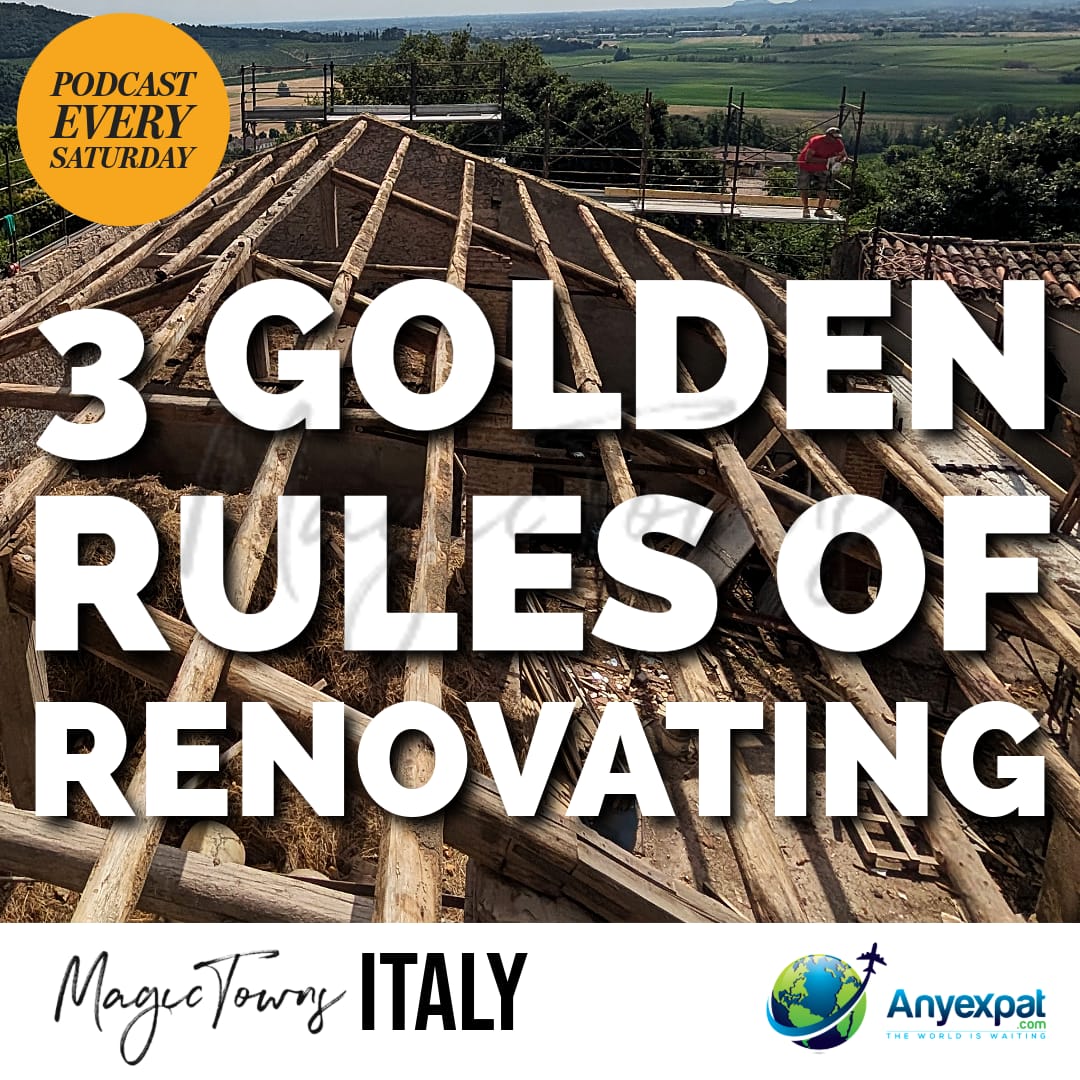
[00:00:00] Luca: We were about to do a podcast on a very sad topic of how Italy’s beautiful natural landscapes are being built over and covered in concrete. But then we decided halfway through that it was so sad. We were going to answer some of your questions instead from when we published the Italian buying property guide last week. [00:00:22] Anna: Yeah, basically Luca is restoring this beautiful villa near Venice and we thought that it was a nice topic to talk about, to share the practical lessons for anyone else dreaming of doing this. [00:00:38] Luca: Thank you. I’m happy to provide my knowledge to our listeners. [00:00:41] Anna: So my question is, how did you end up with this villa to restore? Like why? [00:00:49] Luca: It didn’t fall on my lap, if that’s what you’re asking. And you know that because actually Anna has been helping me a lot with the social media for the project. [00:00:58] This villa Tenuta Augusta was a, I was a bit derelict by the time I set my eye on it. I’ve done quite a few restorations around the world and when I came back to Italy a few years ago, I decided to help to the degree that I am, the country by bringing some old and unloved properties back to life. [00:01:24] And Tenuta Augusta is exactly that. It is a 16th century villa in the countryside, in the hills, not far from Venice. Just as you said. It was built by this nobleman back in the 15 hundreds, his family. And at the beginning it was a working farm. We know this because I went to the National Archives and they found his tax returns from 1671. And at some point they decided to revamp it and live in it . This family then fell into we don’t exactly know what happened. They either ran outta money or they died out, or both. Since no one has that last name anymore in the area. [00:02:09] And then it passed from family to family until an old school teacher owned it for the past 40 years. She died maybe 10 years ago, and then it was just left there to rot. So we made it our mission to bring it back to life. [00:02:28] Anna: I think that renovating this property is like doing a puzzle because you’ve discovered so many things. Just renovating each floor of villa. And an interesting topic that I thought about . What makes us fall in love. We have this willingness of to fall in love with places that we think could be something rather than just find a place that’s ready to live in or in this case to host people. [00:02:56] And sometimes, it’s better because you waste less time on problems, but oh, it’s [00:03:02] Luca: certainly faster to buy something new. [00:03:04] Anna: Yeah. But I’m talking about like the process itself. At a certain point it becomes like a drug. Like you, you fall in love with the process of imagining of the potential itself. Do you want describe a little bit of this? [00:03:19] Luca: That is absolutely true. I have a great degree of admiration for Michaelangelo, who as a great sculptor, he described this creative process as looking at a stone and taking away. The excess, what was on top of the shape that he imagined inside that is so inside. [00:03:41] And that’s too much for me. I think it’s too much for most people to just imagine something new and then have at it, go from idea to creation and maybe a step down from that level of genius and divinity is to take something that was beautiful and restore. It in this case, unfortunately, the owners over the centuries were not very kind to the place and by the 1970s they had stripped away all the wooden floors, they had filled it up with trash and old clothes and all the furniture, and that didn’t present itself very well. [00:04:19] There was a lot of beauty waiting for us and, it didn’t take long for us to start seeing it. In the 1990s, they had actually turned this villa into a car repair shop. So what do we not find it? There are so many things. As you say, it is a, it’s a bit of a drug to see that every day, that’s another step towards bringing beauty back to the light. [00:04:42] Anna: And is it difficult to respect the history of the place when you’re renovating such a property? I’m talking about the original materials. Like for example, you used the original stones that were used for the house. I see. [00:05:02] Luca: Oh, is it easy? No, it isn’t. Why? Because it’s always easier to cut corners. [00:05:08] For instance, and if you check out Anna’s Instagram, you’ll see this, the doors. Were made for people from 400 years ago. Now I know that Italians don’t have a reputation for being very tall, or there are exceptions, but the Italians of 400 years ago were pretty short. Five foot maybe [00:05:28] Anna: Like elves? [00:05:29] Luca: Little bit more than elves. So the doors were just not usable. And my partners have always been people in Northern Europe. I’m actually restoring this with a bunch of Danish partners and people that I’ve worked with in Copenhagen for many years. And I was thinking, okay, if these guys get in, they’re gonna smash their heads against the doors . The stones surrounds of the doors were just stunning. [00:05:57] So we decided to do a, see, this is not cutting corners. We had the local craftsman create stone surrounds that look exactly the same as the original ones. We kept the original ones, but we raised the doors. 20 inches. And then we had this sort of like stone transplant that that showed the old and the new. [00:06:21] So to answer your question, is it easy? No, it is not easy. Is it expensive yet? It can be expensive. You had to decide who you wanna spend your money. For instance, all the old wooden floors we threw out. Because if didn’t make any sense, they were partly rotten. They could have been restored. [00:06:37] It makes itIt sense in our case to essentially rebuild the plastering of the property with hydraulic lime, which is the same product that the Romans used 2000 years ago. It’s maybe 30% more expensive than the modern cement based stuff. [00:06:57] But it was worth it. I think you can tell that we have been true to the spirit of the place. [00:07:03] Anna: Yeah. And for anyone who doesn’t know that, why did you decide to go for that material? [00:07:10] Luca: Hydraulic lime has many interesting properties. You’re not gonna have mold on it. But that’s just, that’s the practical part of it. The cosmetic part of it is that. When you think about going around Venice, imagine you’re walking around Venice, it has just rained. What do you see in your mind? You see those beautiful buildings and the walls are all patchy, right? [00:07:32] A bit wet, a bit dry. That is the effect. The hydraulic lime gives you, the patina of time. So we went straight for that because it makes the place look, makes it look its age [00:07:46] Anna: Absolutely. I think that people will love, like the neighbors will love to see finally Tenuta Augusta beautiful and shining. [00:07:54] Luca: They do come over sometimes, you know where I would say we have never gotten a complaint, but we have gotten a lot of compliments and people come over and they say, oh wow, you guys are doing such a good job. It’s so nice to see this. Some people say, oh, I wanted to buy this. But actually it was for sale for 10 years. So 10, yeah, about 10 years, yeah. That was quite an interesting process too because they had started off with some crazy sum you wanted a million euro for this. And that’s an Italian classic. First sellers are super greedy and then they become desperate. So you have to be patient with Italians. [00:08:32] Anna: And you mentioned that you’ve already done a lot of projects, but focusing on this area, why do you think this place, like this area Veneto was great for project like this one. [00:08:44] Luca: Now it is difficult for me to look at this area with completely unbiased eyes, because after all I’m a Venetian, at heart. I have a great degree of love for my own land. We have a bit of a inferiority complex. Compared to Tuscany, for instance, because it has been so good at selling itself in front of international audiences. The whole project was born in juxtaposition to Tuscany. [00:09:15] I was out for dinner with some friends and partners of mine in Copenhagen about a year and a half ago. And some of these guys at the table, they’re all Danes, right? All Danes except for me. They were saying, oh, I’m thinking of buying in Tuscany. Now, there’s a lot of Danes buying in Tuscany. It’s a bit of an obsession. [00:09:32] And and I told them, listen, why don’t you come over for a week and I will show you around. You think you’re in Tuscany, but you pay a lot less and you’re gonna be much happier. Of course this did happen. They did fly down and I was their tour guide for a week. [00:09:49] We’re friends. So we had a good time, went out for dinner. We cycled, we walked, we visited a few cities, and then we made a little money pot and all of us put some money in, and that’s how the project was born. But what I’m trying to say is, and I’m thinking about a conversation I had with Kasper, one of these people. And he told me what impressed me the most is that I took off in Copenhagen at six o’clock in the morning and I landed in Venice and I was at Tenuta Augusta by nine o’clock in the morning. And that blew his mind. He could just not believe. It was so close to home. And we have direct fights year round. [00:10:31] To answer your question, why we invested here is because we think it is undervalued for the infrastructure it has. [00:10:37] Have a central European infrastructure, you have a clean roads good quality of life. But you also have that feeling that people like, being in the hills. The Italian dream, the Italian vista. [00:10:53] Anna: Yeah, absolutely. Compared to, you mentioned Tuscany. I think that the nearest airport, it depends on where you live, but like the average is two hours to reach it. [00:11:06] Luca: Actually talking about Northern Europeans is that they only have direct flight to Tuscany in a few months of the year. [00:11:11] Anna: Oh, [00:11:12] Luca: okay. And you’re flying into Florence, which is a minor airport by our standard. And then if you have a second home in Tuscany, what do you do with it? You have to fly to Rome the rest of the year and then drive two and a half hours there. So that is what blew their minds. He told me now that we work from home part of the week, I could wake up on Thursday morning, work from Italy Thursday, Friday, spend the weekend and go back to Copenhagen on Monday evening and all of this without having used it up any vacation days. [00:11:39] Anna: Yeah, it’s true. And it’s also true that you can really feel that Italian feeling. People here are so warm compared to other regions in on the north, I think compared to what [00:11:51] Luca: people say. Because there is a stereotype, but Ooh, the people from the north are also [00:11:57] Anna: cold. [00:11:57] No, I don’t think that, oh, [00:11:58] Luca: the weather is so cold. I am looking outside the window and we have, what is the, what is it today? 65 Fahrenheit. 22 degrees. It’s the second week of November. .Anyway, enough. I’m actually curious, since you’ve been acquainted with this project for six months or so, what impressed you the most or what is the memory of the place that you have the dearest in your heart? [00:12:24] Anna: There are so many. I still remember the day when you discovered that inscription upstairs. [00:12:32] Luca: You should explain to our listeners what inscription you’re talking about. [00:12:35] Anna: Yeah, so basically Luca found the date when this house was renovated, and that was [00:12:42] Luca: the 29th of November, 1751. It was renovated in 1751. [00:12:50] Anna: And that was shocking because just cleaning the walls he found that, that inscription, that was rare. [00:12:57] I think. And then talking about like the aesthetic as I said before, the tower. That was great. It was crazy for two reasons. The first one is the history of the tower, because you see that tower and you’re already thinking about a castle about medieval times, but it’s the most recent part of the building and yeah, [00:13:20] Luca: it’s only 200 years old. [00:13:23] Anna: That’s crazy. Yeah. Yeah, because you said basically they built this tower because, it was something cool at the time. Yeah. [00:13:32] Luca: It was fashionable in the 18 hundreds to say, Hey, I’ve got a medieval tower. But actually it was no medieval at all. And everyone that goes there thinks exactly what you said. [00:13:43] It’s a castle. No it isn’t. It’s a villa. What someone thought, it’s like one of those diners where the waitresses are dressed like knights in armor and it is called like the, at the court of King Arthur. That level of authenticity. [00:13:59] Anna: Apart from the history of the tower, like the aesthetic, it was really sad, and now it’s white, it’s shining, and I love what you want to do with that. The fact that you want to turn it into a shower, that’s, I think, the most unique part of a, of the building [00:14:18] Luca: Shower in the tower. [00:14:19] Sounded good, right? It was too good to pass on. Yes. [00:14:22] Anna: Another interesting thing for people that want to invest in this kind of projects is the bureaucratic part. , All the permits. So this is a protected building. So you had to, yes, it has the [00:14:36] Luca: Highest degree of protection [00:14:38] Anna: and you had to follow certain restrictions. [00:14:40] So what were those restrictions and how did you navigate them? [00:14:45] Luca: In some countries, planning is dealt with at the state level. So it’s centralized and it’s exact opposite. It’s managed at the town level. So sometimes you’re lucky you find the town where the town officials are understanding and they want to work with you. [00:15:01] This is the value of what you’re doing. And in some towns they’re just, I am. I work Monday to Friday I have no intention of putting in an ounce of energy more than I have to. So you can be lucky , this is in spite of what the law says. [00:15:16] The best way to deal with bureaucracy is before you even put in a bid on a property that you want to renovate, to go into town hall and have a chat with the town officials. This is not a form of bribery or anything. You’re just having a conversation formalized with them. You say, Hey, I am considering this building to do such and such thing. [00:15:39] I want to renovate in a such and such way. And my experience is that town officials like to be consulted and they want to feel like they are in the loop. This buys you a lot of goodwill. They will tell you immediately if there are going to be any problems or things that you must do, things that you know you can skirt around. [00:16:01] In this case, for instance, although the building has very high protection, and therefore in principle, you could only follow the. The paper says the rules of scientific restoration. That’s pretty scary if you ask me. Scientific restoration. I was thinking of a team of people in coat labs and like very tiny brushes brushing on the stone and thinking, oh geez, that’s gonna take 50 years to fix. [00:16:29] But they quickly made it clear that what they were interested in is that the outside of the property remained the same. But in the inside they were very open to being reasonable. Like they said, that you can’t turn it into a disco. If you wanna rejig the bedrooms a little bit, et cetera, you can do that. [00:16:46] Make sure you use materials that are not out of tune of the place. So no shiny concrete floors. We use wood terracotta. That was very much what we had in mind. So you could say that the best way to get around bureaucracy is through a negotiation process. You bring forth who your idea is and the people who are responsible for, if ultimately they’re responsible for protecting the town, the environment, and the building, they’re not unreasonable people and they’re generally well educated for the job. They will tell you, okay, you want to do that. These are the rules of the game. If you go at bureaucracy with a sledge hammer, bureaucracy doesn’t yield. It bounces back at you and crashes you. The way to deal with it is with a kind word and being open-minded and trying to find a way around obstacles. I would say that’s a general good rule for living in Italy. [00:17:44] Anna: Communication. Lots of people come here and just buy a property without in being informed. [00:17:52] Luca: Exactly. [00:17:52] Anna: They end up paying a lot of money to the wrong people. [00:17:56] Luca: You’re right. Especially when you talk to real estate agents, there, there are good and honest real estate agents that there are a real estate agents whose only sense of ethics is being loyal to themselves. [00:18:10] They wanna sell. They don’t care what happens to you after you buy. And this is how many people end up buying a barn or a, an agricultural building without knowing that they can’t turn it into a habitable space. This is how people buy properties. They have a serious structural issues you want to avoid working with people whose main interesting is how much money can they squeeze out of you. [00:18:37] Anna: And what about the language for those people that wanna buy a property but don’t speak Italian? [00:18:44] Luca: That’s a very good point. [00:18:45] With the Italians, if you don’t speak good Italian, and mind you, Italians are very appreciative of people making an effort. So you don’t need to be Dante and wow everyone with your perfect Italian. The fact that you respect people enough to not walk into the office and immediately start blurting out something in English or French or German and expecting people to understand you, frankly, that would be rude in any country. You don’t want people barging into the DMV and start speaking Italian because they’re gonna say, you know what are you doing? Be humble, be respectful. Try to say a few words in Italian if you can, but if you can’t get understood, find a local that will act as your guide. [00:19:30] A good example in a renovation would be a good architect or a geometra, which is basically a quantity surveyor. Find a person that speaks good English and they will go into the town hall with you. Plus ideally someone from the town itself. So someone who is a known quantity, someone who has a reputation in the town for being not a maverick, but someone who can be respected and have that person be the go-between but do not abdicate to your seat at the table. You have to be there at all times to not, don’t be seen as a foreigner who’s just gonna sit in a cafe somewhere where someone else does the work and takes all the decisions. You wanna be there too. You wanna be seen, and people have to respect what you do if you are seen in person. [00:20:19] This is what this is true for everyone, town officials, architects, the workers at your site. If you are seen in person and you become a person instead of a wallet with a foreign flag on it, then people will be less likely to take advantage of you. And you are going to find that you’ll also build a better network as a result. [00:20:39] Anna: Yeah. Even if you’re a native in that area. [00:20:42] Luca: Exactly. Even if you’re a native, this is true for everyone, not just for foreigners. [00:20:46] Anna: Yeah. Yeah. Absolutely. And what about the budget, [00:20:50] Luca: Maybe I can give a couple of tips. I’m gonna blurt out three golden rules for budgeting. Number one, never hire an architect that works on a percentage. Never hire an architect that works on a percentage a percent [00:21:06] industry. [00:21:07] And you must understand why. Because if you have an architect that works on a 10% commission on your works, their interest in the morning is how do I get Anna to spend another 10,000 euros so I make another thousand euro today. Don’t do it. If an architect insists on this change architect, it has happened to me before they even do it to me. No. I only work on a percentage basis. Okay. You work with someone else. I don’t. I don’t need you. It is none of your business if I decide to have a cheap tile floors or super expensive oak floors because your job is the same. [00:21:45] Second thing, get a lot of quotes. You find a company to give you a quote on the job. Ideally, this is a bit of a cheeky trick, but it’s a good trick. You tell them, Hey, I want to renovate the place. Why don’t you give me an estimate for the works they have to make you a list of the work that they will have to do and give you the price. [00:22:04] Then you get the same quote they gave you. You go to another company, you hide the prices and you say, how much would you charge me for this work? Then you go to a third company, how much would you charge me for this work? Eventually you get four or five quotes. [00:22:17] You will see the prices will be within 30% of one company to the other. Then you pick the one that has the best combination of reputation, and price and terms. If someone gives you 10% less, but they tell you that they don’t want to commit to a delivery date, you could still be waiting after five years after they took 50% as a deposit. [00:22:42] So combination of terms, reputation, and price. The last of these three top tips is have a contingency fund. 10 to 20% no matter what. Don’t be the person that actually this has happened to. A friend of mine and an architect, he did a renovation for the, for this family, and then at the end, the family discovered that they had to pay 4,000 euro to the utilities company to connect to the electricity. [00:23:11] And these guys said, we don’t have the money for this. But do you only live in a house without electricity? This should have been budgeted for before, but it is not really part of the work. So it wasn’t the architect’s fault, it’s just something to consider. [00:23:25] There will always be some unexpected, some unknown unknowns . So if you have 10 to 20% left in your pocket, for any eventuality that is a good thing. And if you don’t end up spending them, that’s great. [00:23:39] I’d say that in these five minutes, that’s the, that’s my condensed wisdom. Then maybe in the future we’ll do another episode about how to budget it properly for the construction project. [00:23:49] Anna: Absolutely. Thank you, Luca [00:23:51] Luca: It’s a pleasure. [00:23:52] If you guys have any questions now we’re into this kind of property mindset because we spent three months writing this property buying guide. If you have any questions that are a deviation to this topic, feel free to send them over and and I will be happy to either answer them ourselves or, we know plenty of experts that we can bring to the podcast to have a little discussion about them. [00:24:13] Thank you for listening. [00:24:15] Anna: Thank you. Bye.
Discover charming Italian towns where owning property is surprisingly affordable. From Umbria to Sicily, uncover hidden gems with rich culture and scenic beauty—each offering...
Discover the expat lifestyle in Malta with insights from Gill and Boba. Compare living in Malta versus Italy on the Magic Towns Italy podcast.
Discover the surprising truths about Italy's rail network in this week's episode of Magic Towns Italy. Explore what data reveals about connectivity, debunking common...