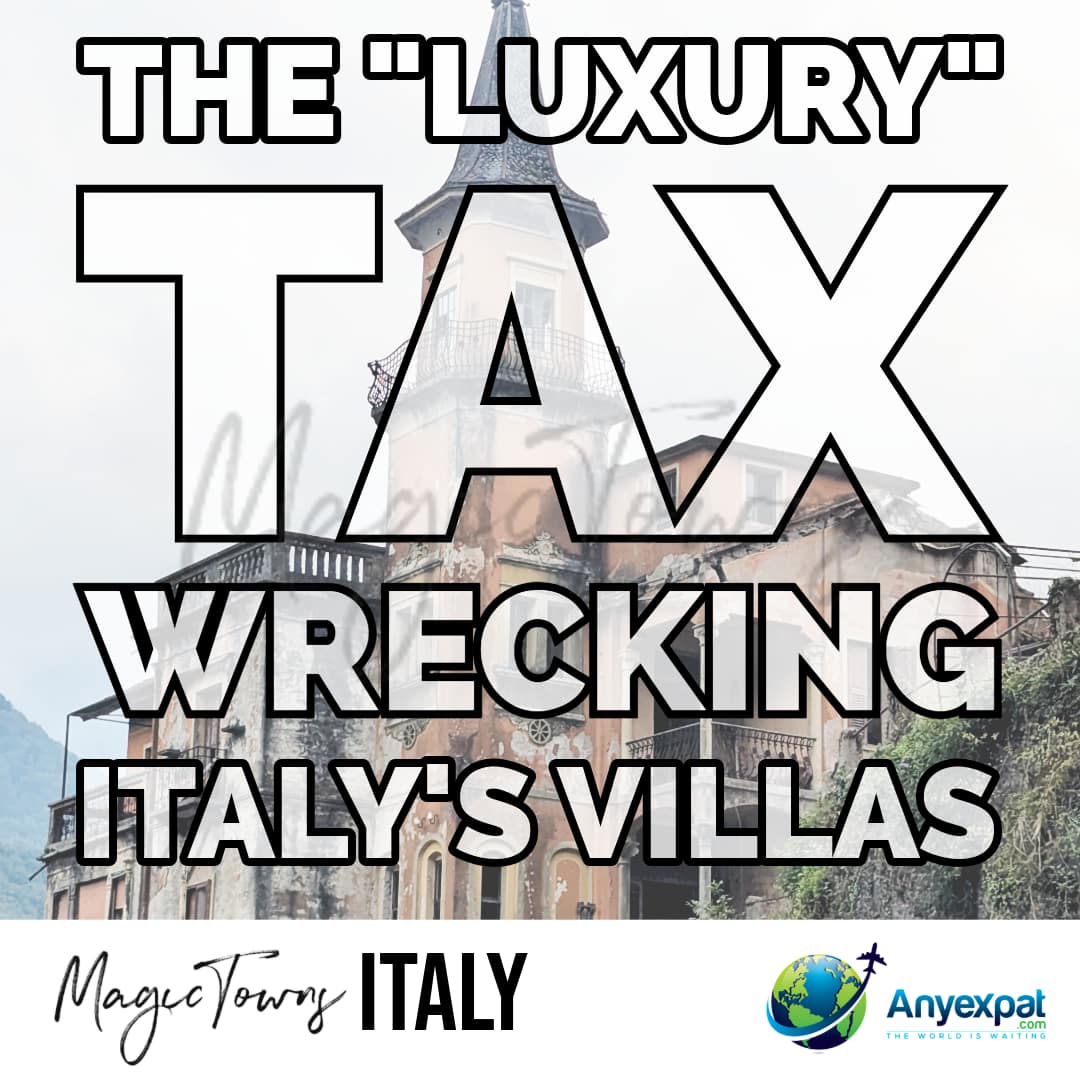
Hosted By


Luca: Happy Saturday everyone, and welcome back to Magic Towns Italy. I’m Luca here with Anna. Good morning, Anna.
Anna: Hi everyone. Hi Luca.
Luca: This week we are talking about a question we get often, which is why are so many wonderful, gorgeous looking Italian villages and castles abandoned, or for sale for what looks like pocket change? I, myself have renovated several properties and I’m always looking for properties.
It’s, uh, as people know, it’s a bit of an addiction for everyone that has it. The area around Venice alone is home to more than 5,000 historical villas. Hundreds of these are in disrepair and sell or sometimes are auctioned for prices as low as 100 or 200,000 euro. And when foreigners see this, they think, oh, Italy’s property market must be broken.
How can it be [00:01:00] so cheap?
Anna: Yeah, exactly. I mean, it sounds too good to be true and usually it is. So today we want to correct that view. The low price is often an illusion and it’s caused by real costs like taxes, you know, renovation works.
So people and especially foreigners are often unaware of.
Luca: That’s right. These properties are not cheap because Italians don’t think the castles or villas aren’t beautiful. They’re cheap because the system makes them very costly to buy and restore. And in the next minutes, we’re going to talk about, uh, Italy’s tax code, the property register system, and the heritage laws that structurally punish historical buildings.
In other words, which part of the bureaucracy makes it so hard to use and maintain these villas?
Anna: Yeah. By the end of this episode, you will understand the reason why these villas and castles languish unsold so we’ll break down the tax traps, the luxury [00:02:00] labels, the heritage protections.
So all the unsexy realities.
Luca: Unsexy realities. Let’s start with tax.
Anna: Yeah.
Luca: 30 second primer on the cadastral category. Please don’t tune out. This is important and most people don’t know what it is. In Italy, there is something called the cadastral category, and it is a code that, indicates what kind of property each property is. Castles, villas are in three of the A categories, A1, A8, or A9. It basically means that, anything that has that label given by the tax man is deemed to be a luxury property from fancy apartments to villas to castles or palazzi.
Anna: But luxury sounds like a good thing. Like why do you say it’s a problem?
Luca: Because in Italy, luxury is basically a tax warning label.
Anna: A warning label,
Luca: yes. There’s a whole set of tax benefits that disappear and more taxes kick in.
Anna: Even [00:03:00] if the place is falling apart.
Luca: Yeah, it doesn’t matter. There can be mushrooms growing through the floorboards, but if the property is tagged as A8 or A9, the tax system treats it like it’s a billionaire’s villa.
Anna: What actually changes?
Luca: The first thing is that you don’t get any first home tax breaks. Normally when you buy a property, you pay 2% purchase tax if you’re gonna go and live in it. In this case, you’re gonna pay 9% whether you live in it or not.
Anna: That’s a big difference.
Luca: Huge. Luxury homes are excluded from the benefit. So for the same house price, you could be looking at paying 70,000 euro tax instead of 15,000.
Anna: Ah, okay.
Luca: Second thing, renovations, uh, normal homes, when you renovated property, you pay 10% VAT rate or sometimes even 4% on all the works. VAT for our US friends is basically our equivalent of sales tax. On luxury homes you pay 22%. So on a big restoration, you can [00:04:00] easily be charged an extra six figures just in tax.
Anna: Just for the label?
Luca: Exactly. Just for the luxury label.
Anna: And that’s not the end of it, is it?
Luca: No. You wish. There’s also IMU, the annual property tax. If you live in a property, you normally don’t have to pay property tax. But,
Anna: but,
Luca: but of course this does not apply if they are luxury. So in that case, if you, even if you live in it, you pay it even if it’s your only home.
Anna: Okay. So higher renovation tax and yearly property tax. That’s brutal.
Luca: Yeah, it is. It discourages normal buyers completely. And it is absolutely possible that a family might afford to buy the house, but not the taxes that come with it.
Anna: So people actively try to avoid the luxury classification?
Luca: Absolutely. Italians would jump through fire to downgrade the property on paper. That label is financial kryptonite.
Anna: And just to clarify, this luxury label [00:05:00] isn’t about actual condition or features.
Luca: Not really. Luxury is just a bureaucratic status. The villa can be missing half of its roof, be rotten through and it still be castle palace because historically it was prestigious. It was labeled as a luxury property and therefore it’s gonna stay like that, for its life.
Historically, the law defines luxury homes based on criteria. Like if it has large parks, if it has certain fine finishes, if it has a very large pool. But recently the Court of Cassation, the equivalent of the Supreme Court said that any property that has more than 240 square meters of livable, usable space is automatically luxury. And I’m not gonna comment on that because it is, I think any one can see that it defies common sense.
It is a blunt instrument. And to answer your question, a derelict villa can be taxed, a hundred percent like it’s a fully functional luxury [00:06:00] estate with solid gold toilets.
Anna: No wonder many owners either try to reclassify the property or just give up and sell. But reclassification must be hard, I imagine.
Luca: Yes. You can’t just wish it and it becomes true. The tax man, actively refuses to reclassify a property. And according to every architect I ever spoke to, it is pratically impossible to do. What some owners do is that they let the property degrade on paper, which leads to a weird trick, that people try to use to avoid paying taxes.
But we’ll talk about that later. The takeaway is, the tax code that treats historic villas as luxuries for the ultra rich pile on the costs, and that drives away normal buyers.
Anna: Okay, so taxes are huge but let’s talk about heritage laws. So many of these grand villas are protected by Italy’s culture, heritage authorities. So in theory, that’s [00:07:00] wonderful because it preserves, you know, the historical integrity
Luca: in practice this heritage protection is a double-edged sword. If the property is officially under the purview of the Superintendents of Fine Arts, the owner is not just the owner, but becomes the custodian of that piece of national heritage. The law says that you must, as the owner, maintain and conserve a protected property, it’s an obligation. The state can even force you to do repairs or in extreme cases, step in, do the works, and then send you the bill.
Anna: So you’re forced to restore it, but at the same time, the state puts strict rules on how you restore, right?
Luca: That’s exactly right. The superintendents, the local arm of the cultural ministry. Has to approve any change you want to make to a protected building. You can’t repaint the ceiling, you can’t change the window frame, you can’t redo the roof without, the green light.
Long [00:08:00] term listeners know that thankfully in Italy, most planning is done at the town level. You can just walk in to town hall and have a discussion with the local architect. And normally this is a good system, but the Superintendence is in large historical cities. For instance, for the Veneto, the superintendents in Verona and in Venice.
And you are sending away your planning application not just to town hall, but to these uh, sometimes obscure entities and they’re not going to rubber stamp your plans. They’re going to impose a specific restoration methods, materials that are in line with historical authenticity and they’re basically co-managing the project with you.
Anna: I imagine that can mean delays and higher costs.
Luca: Superintendence is normally, it takes 60 days to review your plans. If they insist on using certain materials, you must follow their instructions. Maybe you want to put in PVC windows cheap, pretty. Energy efficient and it may cost you [00:09:00] 500 euro each, but they may say you have to add the custom made replicas of 1800s windows made out of solid wood, which would cost you five times more.
They may tell you that you can’t install solar panels. They might tell you that you can’t install the pool because it is not, and I’ve seen it before compatible with the historical background of the building. Their priority is to preserve the heritage, not making your life easy, and certainly not to make you make money.
Anna: Right. They don’t care if you have a comfortable home at the end, they care that the character and integrity of the villa is intact. I recall you saying once that of official would rather see a building crumble than allowing appropriate changes.
Luca: I looked at a 16th century villa, not far away from where I live. One of many examples. It sold for only 60,000 euro and it was so cheap because it was doubly cursed. It was classed as a luxury property with all the tax stigma we, the site we discussed before, and it is heavily [00:10:00] protected by the Superintendence.
A town official told me, basically he admitted that there was nothing that a buyer could do with it that will make it economically viable. The heritage rules were prevented from being turned into apartments. And no one is willing to pour money in just to make, uh, the government happy. So effectively what they said is it is better to let it rot than to allow it to be turned into modern apartments.
Anna: Yeah. That is sad and frustrating. But are there any upsides to property being protected, like any grants or tax deductions to offset this?
Luca: There are some perks, but to be honest, they’re not that great. You can get some tax deductions if you renovate, it’s, you know, pretty small fry. Sometimes, and trust me, this is very rare that are grants that cover a portion of the conservation works. The bottom line is that none of these advantages cover [00:11:00] anywhere near the full cost of, uh, restoring anything, these properties.
Anna: Yeah. So you might save a bit on taxes by doing restoration, but you’ll spend far more complying with the heritage requirements. I recall another catch. So if a building is protected, the owner has to offer this data, right? Offers refusal when selling right.
Luca: If any of these properties are sold, the state effectively has 60 days to buy the property from you at the same price. But to be fair, this is rarely exercised that as the Italian state has a hundred of thousands of historical buildings and no money to buy them or fix them.
Anna: I can imagine a foreign buyer thinking maybe the government or, uh, the EU will give me a big grant to save this villa. But in reality, beyond small tax breaks, you are on your own, basically.
Luca: That’s right. So in practice, this means that often heritage protection discourages individual buyers. And, this [00:12:00] is another factor that is reflected in the low stacker price. The luxury or protection status of a property is rarely advertised by real estate agents because it scares people away. But eventually you’re going to find out, and I mean, you better know what it means before you buy.
Anna: Yeah. Before you talked about industrial trick. So declaring a, building a ruin or not. Let’s get into that.
Luca: The bottom line is that, uh, if you have a building that’s still viable or working on paper, that you pay property tax on it. And if it is classed as a ruin, officially, you don’t pay property taxes on it.
Anna: So if I inherit grandpa’s crumbling villa, I’d want to declare it a ruin to avoid paying property tax every year on a house that I, I can’t even live in.
Luca: Yes, and a lot of people do this, but there’s a huge catch and mostly they come to regret it. Once you declare a property a ruin, if you decide in the future, or if another buyer decides to renovate and make it habitable [00:13:00] again, the law says that it has to meet current standards for habitability.
So let’s say that it was, uh, a house only 1800s. If it was on the books as a US usable house, you can’t bring it back and say, oh, it’s the 18 hundreds all over again. It must now meet all the requirements of 2026 structure systems, energy efficiency, et cetera. As of today’s regulations.
Anna: What would that entail?
Luca: That obviously changes the scope and the cost of the renovation. You will have to add modern insulation, reinforce against earthquakes, install compliant utilities. You have to do this. It’s not optional, and you won’t be able to go back and live in the place again or sell it like a livable place until it’s done.
So in a nutshell, some owners prefer to keep a decaying villa listed as habitable and pay the taxes as come with it, rather than the declare to ruin, because it’s going to make it [00:14:00] unsellable as a ruin, as the buyer would have to go through hell to make it habitable again.
Anna: So either pay taxes on a husk of a building or save on tax now, but pay more in construction later.
Luca: Damned if you do. Damned if you don’t.
Anna: One final thought before we go enjoy our Saturday. We hear that a lot like foreigners dreaming of transforming a palace into a, a beautiful hotel.
Luca: And I’m glad you mentioned this, the entrepreneurial spirit is very welcome. Italy needs, uh, but you have to be careful. Converting a historic villa or castle into a hotel requires the, you guess that the Superintendence to say yes again, because you’re gonna have to make some physical changes and, uh, you’re going to have to convince the town that is fine to turn it in to a commercial building.
Sometimes you can, sometimes you can’t, don’t buy the place, unless you, agree with the seller that you’re going to get permits before you actually fork over the money.
Anna: If you want to take on such a project, good for you. These communities are often [00:15:00] very welcoming of someone rescuing a local landmark. Despite all the hurdles that we mentioned, some people do succeed and create something wonderful.
Luca: Yeah, exactly. We are supporting you from the sidelines. Just, uh, do your maths and be careful and most of all, talk to an architect before signing any papers.
Anna: Exactly.
Luca: We hope this was interesting and, we’ll talk next week.
Anna: Thank you. Bye.
Luca: Thank you.
In this special episode we go through the details of opening a bed & breakfast in Italy, with all the available options, including farmstays,...
Explore the rising cost of coffee in Italy as Luca and Anna discuss breakfast habits, coffee culture, and the economics behind your morning espresso.
Discover key insights on navigating Italian property purchases and renovations as Jan shares her experiences and advice. Avoid common pitfalls!